Annual Report 2025-26
This annual report will be presented to Parliament to meet the statutory reporting requirements of the Police Act 1998, Police Regulations 2014, Public Sector Act 2009, Public Sector Regulations 2025 and the requirements of Premier and Cabinet Circular PC013 Annual Reporting.
This report is verified to be accurate for the purposes of annual reporting to the Parliament of South Australia.
Submitted on behalf of the South Australia Police by:
Grant Stevens APM LEM
COMMISSIONER OF POLICE
From the Chief Executive

2025-26 has been another year of challenges, but it has also been a year filled with achievements of which we can all be proud. As Commissioner of South Australia Police, I am continually grateful for the privilege of leading the agency in delivering essential services to our community.
Our performance over this period reinforces my belief that our police officers, police security officers and non-sworn staff who together make up our dedicated, professional and highly capable workforce are all committed to our vision of delivering safer communities. By building on our past achievements, we will continue to maintain and enhance the high regard in which we are held by South Australians.
SAPOL continues to lead the fight against crime by advancing our systems and methodologies in innovative ways, enabling us to anticipate, counter and combat traditional and evolving criminal behaviours as they emerge.
In May 2026, SAPOL reached its authorised full establishment for the first time since 2018, the only Australian jurisdiction to have done so for years. This milestone strengthens our frontline policing capacity and visibility across metropolitan and regional South Australia.
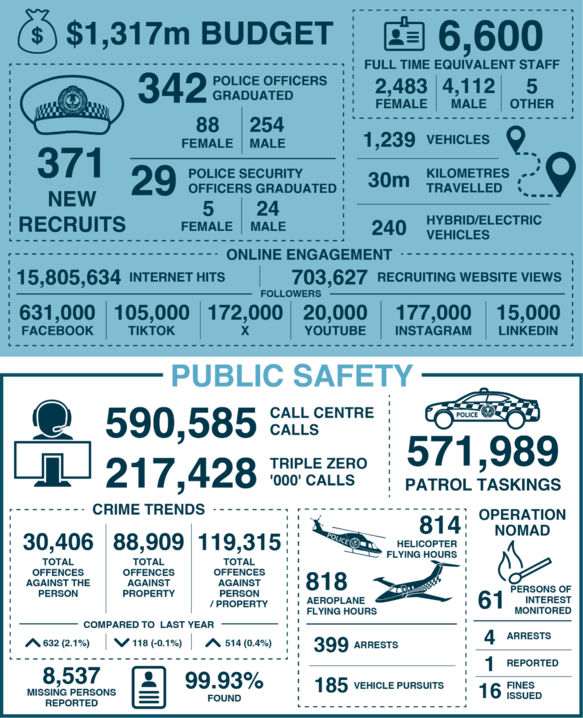
As at 30 June 2026, our frontline policing capability stood at 4 832.4 FTE. During the year, 342 recruits graduated from the Academy. These probationary constables now contribute to a sworn workforce that better reflects the diversity of the South Australian community we serve.
SAPOL also launched a new recruitment campaign, Find Where You Belong in Blue. The campaign builds on the strong foundations of previous recruitment marketing initiatives while highlighting the diversity and breadth of policing roles available within SAPOL. It reinforces the message that at SAPOL you can have “many roles with one employer” while making a meaningful contribution to building safer communities across our State.
In January 2026, to aid SAPOL’s efforts to recruit more than 100 police security officers (PSOs) over the next 12 months, the landmark ‘Go for PSO’ campaign was launched, showcasing the diverse and meaningful career opportunities available as a PSO. The campaign highlights the variety of workplaces people will find PSOs, from government buildings to community spaces, schools and major public events.
Our local and international recruitment campaigns have continued to deliver positive results. SAPOL remains on track to achieve its goal of recruiting 200 police officers from New Zealand, the United Kingdom, the Republic of Ireland and Canada. We are already benefiting from the experience and expertise of those who have graduated and commenced service.
SAPOL also successfully secured $29.6 million in government funding to recruit 98 Police Security Officers by 2028-29. These officers will be deployed to regional South Australia to support growing populations and increasing service demands.
SAPOL’s vision of Safer Communities remains at the forefront of everything we do. To support this vision, we continue to develop and refine strategies and plans that strengthen our policing response.
During 2025-26, we updated Our SAPOL 2030 Strategy and developed a new Corporate Business Plan 2026-2030. These updates respond to an increasingly complex and evolving policing environment and further support SAPOL’s commitment to achieving its vision of Safer Communities.
SAPOL also released a new Serious and Organised Crime Strategy 2025-2028, which delivers a multi-faceted approach to combating serious and organised criminal activity at every level. In addition, we introduced the Suicide Prevention Action Plan 2025-2028, reflecting our commitment to reducing suicide risk both within the South Australian community and across our organisation.
As part of implementing recommendations from the Royal Commission into Domestic, Family and Sexual Violence, and in line with our ongoing commitment to strengthening responses to domestic, family and sexual violence, SAPOL established the Domestic, Family and Sexual Violence Service during 2025-26. This dedicated service provides governance and policy leadership to support implementation of the Royal Commission’s recommendations, the criminalisation of coercive control, and the continued adoption of best practice approaches.
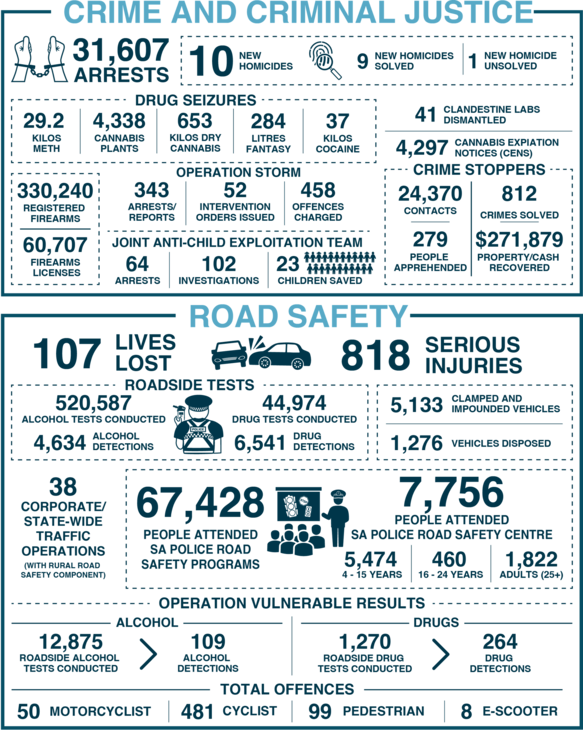
Operation Storm targets domestic abuse offenders through a focused deterrence model involving intensified interventions and the application of lawful authorities proportionate to risk. The operation seeks to proactively identify and take action against offenders who pose a threat to victims, contributing to safer communities. During 2025-26, Operation Storm resulted in 343 arrests and reports, 458 offences charged, and 52 intervention orders issued.
In December 2025, the independent BDO review of the District Policing Model concluded. The review involved extensive consultation, analysis of SAPOL’s integrated systems and consideration of a broad range of perspectives to ensure practical and meaningful outcomes. I fully accepted the review’s findings and implemented several immediate changes aimed at relieving frontline pressures, building organisational capacity and empowering local decision-making. I remain committed to significant reform to ensure policing in South Australia remains sustainable and fit for purpose.
Effective from 1 July 2025, regional Local Service Areas were renamed Regions. This change recognises the vast geographical areas our regional employees serve and better reflects the diversity and uniqueness of these communities. The BDO Regional Policing Future Directions Project was also undertaken during the reporting period, with the outcomes to be reported in next year's annual report.
The SAPOL Mobile Workforce Program continues to deliver mobile technology solutions, including mobile devices, peripherals and connectivity for in-field, in-vehicle and office-based work environments. These enhancements enable personnel to work more efficiently, respond more quickly and provide improved services to the South Australian community. During the reporting period, SAPOL deployed 3 400 mobile devices, with rollout to the State Operations Service scheduled for completion in the next financial year.
This year, SAPOL completed renovations to the Two Wells Police Station, providing a safer, larger and more suitable facility for members and administrative staff. The Academy’s Weapons Training Building was also redeveloped, enhancing day-to-day firearms training, supporting future capability development and strengthening our training foundations.
Policing can be a dangerous profession. This year, nine sworn members were awarded the Police Bravery Medal for acts of exceptional courage that saved lives. I congratulate Sergeant First Class Mark Buckingham, Senior Sergeant Andrew Suter, Brevet Sergeant Steven Birchall, Senior Constable Geoffrey Munn, Constable Nathan Cranwell, Constable Elisabeth Pergoleto, Brevet Sergeant Adam Vonow, Senior Constable Trent Clark and Brevet Sergeant Stuart Norman on their outstanding service.
Other notable recognition during 2025-26 included Detective Senior Sergeant Heath Lienert receiving the Outstanding Dedication Award from the International Outlaw Motorcycle Gang Investigators Association for his contribution to the investigation and disruption of outlaw motorcycle gangs. The Far North Family Violence Team in Port Augusta was also named joint winner of the Outstanding Service Award – Regional Impact at the South Australian Child Protection and Family Support Awards in September 2025, recognising its strong partnership with the Department of Child Protection and tireless efforts to improve outcomes for children and young people in rural and remote communities.
In August 2025, Police Horse Vulcan, a much-loved and long-serving member of the Mounted Operations Unit for almost 20 years, passed away. Vulcan will be remembered not only for his years of distinguished service but also for the quiet dignity and trust he brought to every interaction. In recognition of his contribution, he was posthumously awarded the Australian Animal Distinguished Service Award.
In September 2025, four-year-old Gus Lamont disappeared from his family’s remote property, Oak Park Station. SAPOL’s commitment throughout the extensive search for Gus has remained unwavering. This represents the largest search operation of its kind ever conducted in South Australia. While, sadly, there has not yet been a resolution despite eleven large-scale searches, we remain committed to finding Gus.
Working closely with the Government, new legislation was introduced to strengthen responses to knife-related offending, resulting in the toughest knife laws in Australia. These laws, particularly those relating to declared shopping centres, are helping SAPOL proactively identify risks and prevent harm. During a three-month period, Operation Surrender facilitated the anonymous surrender of 3 508 weapons.
In February 2026, SAPOL successfully launched South Australia’s public-facing Child Sex Offender Register (CSOR), representing a significant milestone in strengthening child safety and community protection. CSOR provides parents, guardians and community members with access to specific information for child-safety purposes. The register incorporates robust safeguards to ensure information is used appropriately and to prevent misuse, reflecting a broader commitment to delivering smarter services that support and empower communities.
The Joint Anti-Child Exploitation Team, comprising SAPOL and the Australian Federal Police, safeguarded 23 children, conducted 102 investigations and made 61 arrests for child exploitation offences during the reporting period.
Road safety remains a major focus for SAPOL, as every fatality or serious injury has a devastating impact on individuals, families and communities. Every member of our community must remain vigilant, avoid risky behaviours and never become complacent on our roads.
SAPOL’s new Road Safety Ambassador, Ms Abigail Anderson, is working closely with our Road Safety Section to share her powerful story of losing her younger brother Nathan, who was tragically killed in a motorcycle crash. Abigail hopes her message resonates with young drivers and riders, encouraging safer choices and greater responsibility on our roads. Her message is clear, road trauma changes lives forever.
Sadly, during the financial year, there were 107 lives lost and 818 people suffered serious injuries on South Australian roads.
As part of our road safety strategy, SAPOL continues to focus on enforcement and prevention. During 2025-26, police conducted more than 520 000 roadside alcohol tests, resulting in 4 634 detections, and more than 44 900 roadside drug tests, resulting in 6 541 detections. In addition, cocaine was added to the list of prescribed drugs that SAPOL can test for (alongside methamphetamine, THC and MDMA). Throughout the year, 7 756 people attended the SAPOL Road Safety Centre, including 5 474 children, 460 young adults and 1 822 adults.
I would like to thank all SAPOL employees for the professionalism, dedication and resilience they have demonstrated over the past 12 months. Despite increasing demand and the many challenges we have faced, the South Australian community continues to voice its strong confidence in the work we do. Together, we will continue to deliver on our vision of safer communities for all South Australians.
Overview: about the agency
Our Purpose | Under the Police Act 1998 (SA), the purpose of South Australia Police (SAPOL) is to reassure and protect the community in relation to crime and disorder by the provision of services to uphold the law; preserve the peace; prevent crime; assist the public in emergency situations; co-ordinate and manage responses to emergencies; regulate road use and prevent vehicle collisions.Under the Police Act 1998, the purpose of South Australia Police (SAPOL) is to reassure and protect the community in relation to crime and disorder by the provision of services to uphold the law; preserve the peace; prevent crime; assist the public in emergency situations; co-ordinate and manage responses to emergencies; regulate road use and prevent vehicle collisions. |
Our Vision | SAPOL’s vision of ‘Safer Communities’, recognises our continuing commitment to reduce community harm through a prevention first mindset. |
Our Values | To achieve our vision, we need to ensure our culture reflects the best personal and professional qualities for trusted and sustainable working practices. Our values that guide our behaviour and attitude are Service, Integrity, Leadership, Collaboration, Courage and Respect. |
Our functions, objectives and deliverables | SAPOLs Our Strategy 2030 and Safer Communities vision recognises police as a valued contributor to the safety and prosperity of the South Australian community. The foundation for SAPOLs quality service delivery is guided by our five principles of:
Our core programs in 2025-26 were:
|
Our organisational structure
- Commissioner
- Deputy Commissioner
- Business Service
- Crime Service
- Domestic, Family and Sexual Violence Service
- Governance and Capability Service
- Information Systems and Technology Service
- Metropolitan Operations Service
- Operations Support Service
- People, Culture and Wellbeing Service
- Security and Emergency Management Service
- State Operations Service
https://www.police.sa.gov.au/about-us/organisational-structure
During 2025-26 there were the following change to the agency’s structure and objectives as a result of internal reviews or machinery of government changes:
- Following the release of the SA Governments response to the Royal Commission report into Domestic, Family and Sexual Violence, SAPOL established the Domestic, Family and Sexual Violence Service.

The Hon Michael Brown MP is the Minister for Police. His other portfolios include Minister for Correctional Services and Minster for Consumer and Business Affairs.
The Minister oversees South Australia Police programs of Public Safety, Crime and Criminal Justice Services and Road Safety.
| Grant Stevens APM LEM is the Commissioner of Police, responsible for leading South Australia Police and the State Coordinator under the Emergency Management Act 2004 (SA). Areas reporting directly to the Commissioner include:
|
| Linda Williams APM LEM is the Deputy Commissioner, responsible for assisting the Commissioner in leading South Australia Police. Areas reporting directly to the Deputy Commissioner include:
|
| Stephen Johinke is the Executive Director Business Service, responsible for:
|
| Cath Hilliard APM is the Acting Assistant Commissioner Crime Service, responsible for:
|
| Stuart McLean APM is the Assistant Commissioner of the newly formed Domestic, Family and Sexual Violence Service. This will enhance SAPOL’s capability, coordination and focus in responding to domestic, family and sexual violence across the community. |
| Simon Watkins is the Assistant Commissioner Governance and Capability Service, responsible for:
|
| Richard Hill is the Executive Director Information Systems and Technology Service, responsible for:
|
| David O’Donovan is the Acting Assistant Commissioner Metropolitan Operations Service, responsible for:
|
| Narelle Kameniar is the Assistant Commissioner Operations Support Service, responsible for:
|
| Kim-Sherie Summers is the Executive Director People, Culture and Wellbeing Service, responsible for:
|
| Philip Newitt APM is the Assistant Commissioner Security and Emergency Management Service, responsible for:
|
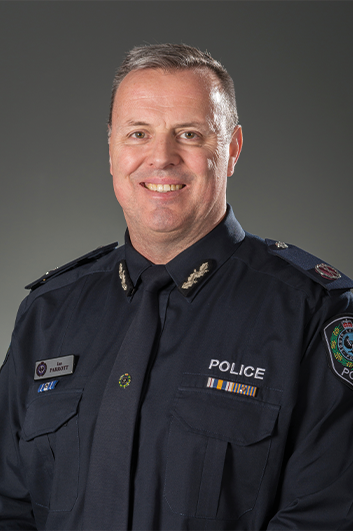
| Ian Parrott APM is the Assistant Commissioner State Operations Service, responsible for:
|










- Police Act 1998 (SA)
- Police Regulations 2014
- Firearms Act 2015 (SA)
- Hydroponics Industry Control Act 2009 (SA)
- Public Assemblies Act 1972 (SA)
- Second-hand Dealers and Pawnbrokers Act 1996 (SA)
- Witness Protection Act 1996 (SA)
South Australia Police continue to work collaboratively with other emergency services and government agencies, including the Department for Correctional Services to support community safety.
The agency's performance
| Agency objectives | Indicators | Performance |
|---|---|---|
| Protective vests to protect all frontline police | Procurement and provision of additional Multipurpose Load Bearing Vests (MPLBVs) for frontline police. | 734 MPLBV's delivered |
| Public Safety |
Level of Community Confidence in policing services. Percentage of Grade 1 taskings in the metropolitan area responded to within 15 minutes. Number of calls received by Call Centre. Number of 000 calls presented to Police Communications Centre by Telstra. |
73.2%* 93.5% above the target of 80% 590 585 217 428 |
| Crime and Criminal Justice Services |
Number of recorded offences against the person as reported by/on behalf of victims per 1000 head of population. Number of recorded offences against property as reported by/on behalf of victims per 1000 head of population. |
15.9 above the projection of ≤15.3 46.5 below the projection of ≤50.2 |
| Road Safety |
Number of Road Safety Contacts issued personally involving unique expiation notices and apprehension reports/incidents reports excluding camera. Number of driver screening tests conducted. Number of SAPOL Road Safety Centre attendees, children, young adults (16-24 years) and adults (25+). Total number of people attending SAPOL road safety programs. |
170 644 520 587 above the target of 500 000 5 474 children, 460 young adults and 1 822 adults 67 428 |
* As a result of a significant national data collection methodology change in the National Survey of Community Satisfaction with Policing in 2023-24, previous year results are no longer comparable.
Crime Trends
Offence counts and groupings are in line with the Australian Bureau of Statistics (ABS) Australian and New Zealand Standard Offence Classification (ANZSOC). SAPOL updated crime recording and reporting systems from 1 July 2025 to align with a major crime coding revision required by the Australian Bureau of Statistics.
Over the five year period from financial year 2021-22 to 2025-26 there has been an increase in overall recorded crime of 6% or 7 196 offences (112 119 to 119 315) for total offences against person and property.
In summary, from 2024-25 to 2025-26, there was a slight increase in overall recorded crime of 0.4% or 514 offences (118 801 to 119 315)
Total Offences Against Person and Property
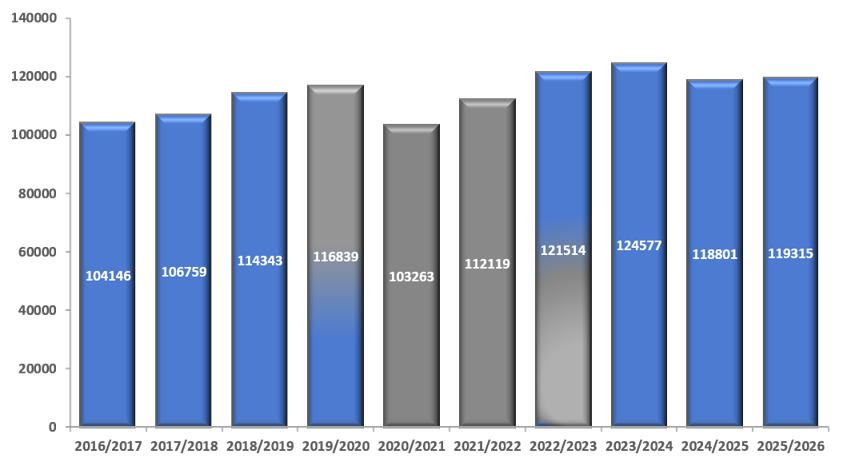
Note: to align with SAPOL`s regular monthly crime data reporting the previously published 2024-25 data has been refreshed
 COVID-19 period March 2020 - August 2022.
Crime statistics are published online at Crime Statistics each month.
Total Offences Against the Person
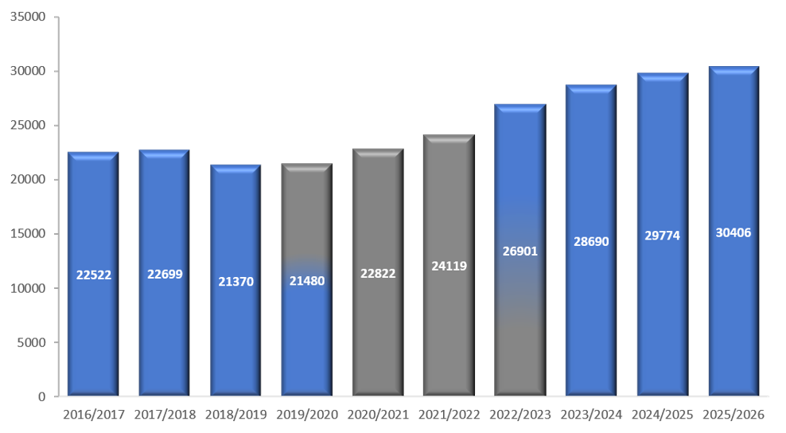
Note: to align with SAPOL’s regular monthly crime data reporting the previously published 2024-25 data has been refreshed.
COVID-19 period March 2020 - August 2022.
OFFENCES AGAINST THE PERSON | Financial Year | ||
|---|---|---|---|
2024-25 | 2025-26 | Change | |
Homicide and Related Offences | 57 | 45 | -21% |
Assault | 23 733 | 24 157 | +2% |
Sexual Offences | 2 738 | 2 683 | -2% |
Harm or Endanger Persons | 2 518 | 2 847 | +13% |
Robbery, Blackmail and Extortion | 728 | 674 | -7% |
TOTAL OFFENCES AGAINST THE PERSON | 29 774 | 30 406 | +2% |
Family & Domestic Abuse-Related | 13 822 | 14 630 | +6% |
* SAPOL updated crime recording and reporting systems from 1 July 2025 to align with a major crime coding revision required by the Australian Bureau of Statistics. As a result, there are changes to the look of the crime tables that include Person offences. Offence nomenclature, including shortening of descriptions, and visibility of some offence groupings that have changed in a nationally consistent approach to reporting crime.
Homicide and related offences decreased by 21% (-12 offences). Within this category, Murder decreased by 33%
(-4 offences).
Assault increased by 2% (424 offences). Within this category, Common Assault increased 16% (881 offences).
Sexual Offences decreased by 2% (-55 offences). Within this category, Aggravated Sexual Assault decreased by
1% (-13 offences), Non-Aggravated Sexual Assault decreased by 20% (-100 offences) and Other Sexual Offences increased by 31% (96 offences).
Harm or Endanger Persons increased by 13% (329 offences). Within this category, Acts that Threaten, Harass or Control increased by 4% (75 offences) and Other Acts that Harm or Endanger Persons increased by 29%
(178 offences).
Robbery, Blackmail and Extortion decreased by 7% (-54 offences). Within this category, Robbery decreased by
12% (-59 offences).
Total Offences Against Property
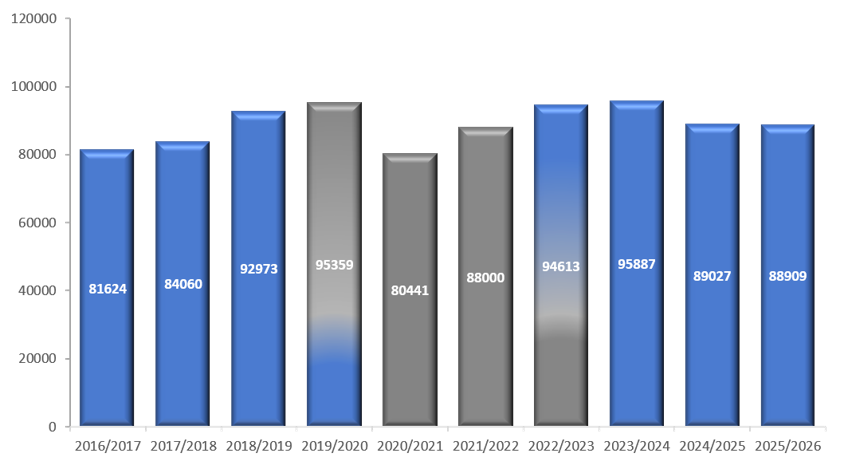
Note: to align with SAPOL’s regular monthly crime data reporting the previously published 2024-25 data has been refreshed.
COVID-19 period March 2020 - August 2022.
OFFENCES AGAINST PROPERTY | Financial Year | ||
|---|---|---|---|
2024-25 | 2025-26 | Change | |
Serious Crime Trespass | 12 326 | 12 732 | +3% |
Theft | 50 768 | 49 838 | -2% |
Fraud, Deception and Related Offences | 3 981 | 4 180 | +5% |
Property Damage | 21 952 | 22 159 | +1% |
TOTAL OFFENCES AGAINST PROPERTY | 89 027 | 88 909 | -0.1% |
Family & Domestic Abuse-Related | 4 490 | 4 658 | +4% |
* SAPOL updated crime recording and reporting systems from 1 July 2025 to align with a major crime coding revision required by the Australian Bureau of Statistics. As a result, there are changes to the look of the crime tables that include Property offences. Offence nomenclature, including shortening of descriptions, and visibility of some offence groupings that have changed in a nationally consistent approach to reporting crime.
Serious Criminal Trespass (SCT) Offences increased by 3% (406 offences). Within this category SCT-Residence increased by 3% (173 offences) and SCT-Non-Residence increased by 1% (33 offences).
Theft decreased by 2% (-930 offences). The main contributor in this category is Theft from a Person which decreased by 11% (-1 555 offences).
Fraud and Related Offences increased by 5% (199 offences). Within this category, Obtain Benefit by Deception increased by 10% (365 offences).
Property Damage increased by 1% (207 offences). The sub-category of Damage or Destroy Property increased by 1% (294 offences).
Total Offences Against Good Order
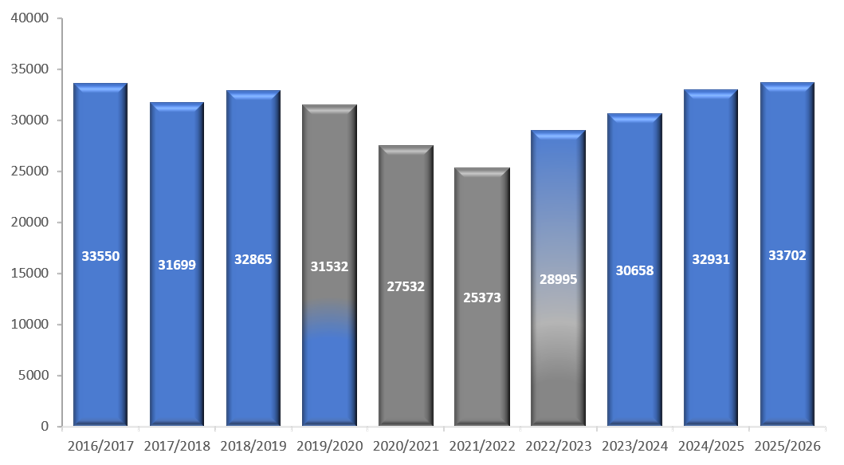
Note: to align with SAPOL’s regular monthly crime data reporting the previously published 2024-25 data has been refreshed.
COVID-19 period March 2020 - August 2022.
OFFENCES AGAINST GOOD ORDER | Financial Year | ||
|---|---|---|---|
2024-25 | 2025-26 | Change | |
Drug Offences | 4 510 | 5 069 | +12% |
Weapons and Explosive Offences | 3 070 | 3 371 | +10% |
Public Order, Health and Safety Offences | 4 994 | 4 889 | -2% |
Offences against Justice Procedure and Orders | 19 963 | 20 010 | +0.2% |
Other Miscellaneous Offences | 394 | 363 | -8% |
TOTAL OFFENCES AGAINST GOOD ORDER | 32 931 | 33 702 | +2% |
* *SAPOL updated crime recording and reporting systems from 1 July 2025 to align with a major crime coding revision required by the Australian Bureau of Statistics. As a result, there are changes to the look of the crime tables that include Good Order offences. Offence nomenclature, including shortening of descriptions, and visibility of some offence groupings that have changed in a nationally consistent approach to reporting crime.
Drug Offences increased by 12% (559 offences). The main contributor is Unlawful Possession or Use of Drugs which increased by 30% (632 offences).
Weapons and Explosives Offences increased by 10% (301 offences). The main contributor is Unlawfully Obtain, Possess or Use Weapons or Explosives which increased by 58% (1 187 offences).
Public Order, Health and Safety Offences decreased by 2% (-105 offences). Within this category, Disruptive Conduct decreased by 3% (-92 offences).
Offences Against Justice Procedure and Orders increased by 0.2% (47 offences). Within this category, Breach of Restraining Order increased by 36% (1 639 offences).
Total General Expiations, Cannabis Expiations and Drug Diversions

Note: to align with SAPOL’s regular monthly crime data reporting the previously published 2024-25 data has been refreshed.
COVID-19 period March 2020 - August 2022.
GENERAL EXPIATION OFFENCES | Financial Year | ||
|---|---|---|---|
2024-25 | 2025-26 | Change | |
Other Thefts (GENs) | 734 | 500 | -32% |
Other Property Damage and Environmental (GENs) | 6 | 11 | +83% |
Cannabis Expiations Notices (CENs) | 4 078 | 4 297 | +5% |
Drug Diversions | 3 232 | 3 445 | +7% |
Other Weapons/Explosives Offences (GENs) | 61 | 50 | -18% |
Other Public Order Offences (GENs) | 5 592 | 5 725 | +2% |
Other Justice Procedure Offences (GENs) | 113 | 114 | +1% |
Other Miscellaneous Offences (GENs) | 427 | 393 | -8% |
TOTAL | 14 243 | 14 535 | +2% |
Total General Expiations (GENs) increased by 2% (292 GENs).
Other Theft (GENs) decreased by 32% (-234 GENs). This category mainly comprises Fare Evasion on Bus/Train/Taxi/Train, followed by Fail to Pay an Entrance Fee.
Cannabis expiation notices (CENs) increased by 5% (219 CENs) and Drug Diversions increased by 7%
(213 diversions).
Other Public Order Offences (GENs) increased by 2% (133 GENs). This category comprises Possess Liquor in Public Place Contrary to Prohibition, Consume Liquor in Public Place Contrary to Prohibition and Smoking in Vehicle while Child Present.
Program name | Performance |
|---|---|
| First Nations Employment | SAPOL is committed to supporting government initiatives and programs that support the employment of Aboriginal people within the public sector. The SAPOL People Strategy 2021-2025 has one of its key priorities to attract, develop and retain a diverse workforce with an inclusive culture within SAPOL. The upcoming 2026 People Strategy which is in its final stages of development, also addresses the importance of building First Nations representation. In 2025-26, SAPOL launched First Nations specific recruitment materials, commissioning specific artwork through a local First Nations company and showcasing First Nations police, police security, community police and administration employees. SAPOL now has a dedicated First Nations recruitment page on Achievemore - First Nations Recruitment, a page linked via QR code on expo postcards and posters to drive quality traffic to the SAPOL recruitment site. First Nations recruitment merchandise has SAPOL has developed an APY/Yalata Police Liaison Officer and Community Constable Training Framework. The framework has been developed based on a pilot program and onboarding of new employees in September 2024. The approved framework enables future onboarding opportunities and contemporary training programs for new employees in remote Aboriginal communities. SAPOL has approved a new Community Police Progression Framework. The key focus of the framework is to better recognise and validate community police classification/increment progressions, while enhancing the development and capability of community police (Community Constables). The framework is expected to further enhance the development and retention of First Nation Community Constables. The Office of the Commissioner for Public Sector Employment Aboriginal Employment Register is available to be accessed when filling non-sworn vacancies and consideration is being given to the register as vacancies arise. |
| Pathway to Policing | The Pathway to Policing Program helps Year 12 students develop the knowledge, skills, abilities, and qualities required for a policing career. The program, delivered in partnership with Thebarton Senior College, is intended to improve the likelihood of successful recruitment of school leavers into SAPOL. Four program graduates were employed as cadets during 2025-26: two from the 2024 program and two from the 2025 program. A modified version of the program was delivered for the first time in January 2026 to Year 11 students from Roma Mitchell Secondary College. |
| Discover SAPOL Work Experience Program | Discover SAPOL is a work experience program for secondary students in Years 10 to 12 who are interested in pursuing policing as a future career. The program introduces students to core policing principles through presentations, excursions, and project work, with up to 80 students participating in the program annually. Six former program participants were employed across police officer, police security officer, cadet, and PSO trainee roles during 2025-26. Of these, one identifies as First Nation |
Performance management and development system | Performance |
|---|---|
Individual Performance Management | SAPOL’s online Individual Performance Management and Development system (iEngage performance and development) runs over a 12 monthly cycle with a mid-term review six monthly before completing and recommencing. Introduced in November 2019, iEngage is focused on promoting a meaningful and purposeful feedback framework between employees and supervisors that will ensure ongoing development of the individual whilst incorporating wellbeing, performance improvement and workplace behaviour expectations. Underpinning this approach is the expectation of regular performance and development discussions between supervisors and employees. The system has two primary elements:
All eligible employees are required to have an up-to-date iEngage performance and development plan. Compliance is monitored and reported through the Executive Leadership Team monthly. |
Program name | Performance |
|---|---|
Work Health and Safety | A total of 2 942 incidents were reported in the 2025-26 financial year, representing a 7% increase compared to 2024-25. Of these, 1 329 resulted in injury and 1 613 resulted in no injury. Additionally, a total of 331 hazard reports were submitted reflecting a 55% increase compared to 2024-25. In August 2025, SAPOL released its Suicide Prevention Action Plan 2025-2028, a significant initiative that demonstrates the organisation’s ongoing commitment to mental health and wellbeing. The plan provides a framework for strengthening suicide prevention efforts and supporting those impacted by suicide within SAPOL and the wider community. In October 2025, SAPOL promoted the annual Safe Work Month campaign, aligned with the National Safe Work Month. The campaign theme: 'Safety: Every Job, Every Day’ reinforced the importance of integrating health, safety and wellbeing into all workplace activities and decision-making. SAPOL has 124 nominated Health and Safety Representatives who provide a consultation and representation function across all services. A structured Pre and Post Worksite Inspection program was introduced to ensure the safety and suitability of new, refurbished, or modified workspaces before employees occupy them. The program provides a consistent process for identifying and addressing hazards, verifying that safety, ergonomic, and operational requirements have been met, and ensuring any risks associated with infrastructure changes are effectively managed. This proactive approach has strengthened assurance that work environments are safe, compliant, and fit for purpose, supporting the health, safety, and wellbeing of workers. The Worksite Inspections program achieved a 98% completion rate in 2025-26, supporting the proactive identification of workplace health and safety hazards and management of associated risks. SAPOL offers an Annual Influenza Program to support employee health and wellbeing and reduce the risk of seasonal influenza transmission in the workplace. The program provides employees with access to free influenza vaccination through workplace clinics and approved vaccination providers. In 2025-26, a total of 2 440 workers received an influenza vaccination through the program. During 2025-26, the Commissioner’s Office Health Safety and Welfare Advisory Committee convened six times, discussing employee health, safety and wellbeing matters while monitoring performance trends and compliance with relevant work health and safety legislation. |
Employee Assistance | The Employee Assistance Program (EAP) is a confidential service provided by external service provider Corporate Health Group. The service is available to all employees and immediate family members, where up to six sessions are provided every two years. The EAP is based on an early intervention model, recognising that timely access to professional support can help reduce the risk, severity, or duration of psychological injury. The program is delivered by qualified mental health professionals and provides short-term support for a range of work-related and personal matters. During 2025-26 the EAP recorded 325 initial consultations representing a 5% decrease compared to 2024-25. Overall utilisation increased, with a total of 1 220 consultations, representing a 19% increase compared to 2024-25. |
Early Intervention | SAPOLs early intervention processes are designed to proactively support employees who experience a work-related injury/illness, with the aim of minimising the impact and duration of symptoms and absence from work. Recovery and return to work needs are assessed within 48 hours of an incident being reported. This is achieved through direct contact with both the injured employee and their supervisor. For employees who sustain a physical injury but remain at work, the program provides timely access to treatment through preferred health providers. Early access to care supports recovery while enabling employees to maintain their work duties where appropriate. Where an employee is absent from work or requires more intensive intervention, referrals are made to appropriate services to support the highest practicable level of physical and/or psychological recovery. Participation in the Early Intervention Program (EIP) is voluntary and does not affect an employee's entitlement to lodge a Return to Work (RTW) claim. In 2025-26, 94% of early intervention assessments were completed within two business days of an injury being reported. A total of 943 early intervention assessments were completed during the reporting period. Of these:
The most common injury mechanisms managed through the EIP included body stressing, being struck by moving objects, falls, trips and slips, and vehicle-related incidents. Due to rounding of numbers to the nearest decimal place, the manual addition of data may vary by up to 1. |
Reconditioning Program | SAPOL maintained a range of health and wellbeing initiatives designed to promote healthy living and improve the overall health of the workforce by delivering evidenced based education/advice, providing health and fitness equipment and offering support to those in need. The Reconditioning Program links staff with appropriate allied health service providers and helps by covering out of pocket expenses. All employees wishing to improve their physical health may access the program, excluding circumstances of work-related injuries. In 2025-26, 406 new applications were received, representing a 2% decrease from 2024-25. The Reconditioning Program is supported by SAPOL’s ‘Preferred Health Service Providers List’ which currently has over 400 allied health practitioners to provide tailored services for the unique nature of policing. Services are provided by dieticians, physiotherapists, exercise physiologists, podiatrists and sleep clinicians. |
Voluntary Health Assessments | SAPOL provides access for employees to receive body composition information using the InBody scan unit. Employees receive individual data including their muscle mass, visceral fat levels and basal metabolic rate which can inform planning and decision making with allied health practitioners to achieve physical health improvements. A total of 966 body composition assessments were conducted in 2025-26. |
Fitness Passport | SAPOL employees and their immediate family have the benefit of reduced rate access to a variety of health and fitness centres across the state. This multi-facility “passport” has 975 current members, representing a 3% increase in users compared to 2024-25. |
Workplace injury claims | Current year 2025-26 | Past year 2024-25 | % Change (+/-) |
|---|---|---|---|
Total new workplace injury claims* | 403 | 383 | +5% |
Fatalities | 0 | 0 | 0% |
Seriously injured workers** | 0 | 0 | 0% |
Significant injuries*** (where lost time exceeds a working week, expressed as frequency rate per 1000 FTE) | 29.2 | 28.2 | +4% |
*Excludes additional compensation claims
**Number of claimants assessed during the reporting period as having a whole person impairment of 30% or more under the Return to Work Act 2014 (Part 2 Division 5)
***As at 31 March 2026
Work health and safety regulations | Current year 2025-26 | Past year 2024-25 | % Change (+/-) |
|---|---|---|---|
Number of notifiable incidents (Work Health and Safety Act 2012, Part 3) | 30 | 20 | +50% |
Number of provisional improvement, improvement and prohibition notices (Work Health and Safety Act 2012 Sections 90, 191 and 195) | 11 | 16 | -31% |
Return to work costs* | Current year 2025-26 | Past year 2024-25 | % Change (+/-) |
|---|---|---|---|
Total gross workers compensation expenditure ($) | $27,873,254 | $25,803,773 | +8% |
Income support payments - gross ($) | $14,310,421 | $12,698,128 | +13% |
*Based on 12 months of data before third party recovery.
Data for previous years is available at: https://data.sa.gov.au/data/dataset/annual-reporting-data
Executive classification | Number of executives |
|---|---|
Commissioner | 1 |
Deputy Commissioner | 1 |
Assistant Commissioners | 7 |
SA Executive Service Level 2 | 3 |
SA Executive Service Level 1 | 17 |
Data for previous years is available at: https://data.sa.gov.au/data/dataset/annual-reporting-data
The Office of the Commissioner for Public Sector Employment has a workforce information page that provides further information on the breakdown of executive gender, salary and tenure by agency.
Financial Performance
The following is a brief summary of the overall financial position of the agency. The information is unaudited. Full audited financial statements for 2025-26 are attached to this report.
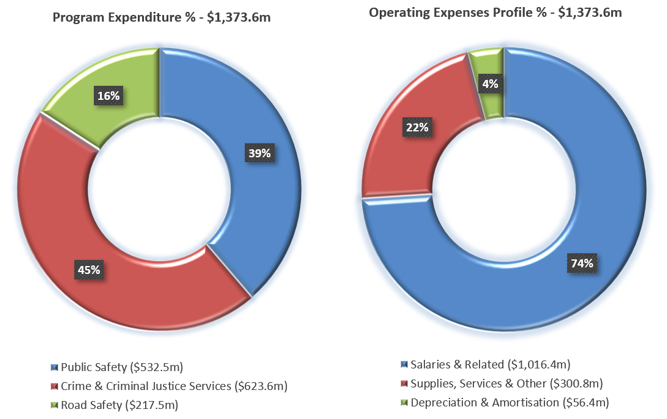
Statement of Comprehensive Income | 2025-26 *Budget $000s | 2025-26 Actual $000s | 2025-26 Variation $000s | Past year 2024-25 $000s |
|---|---|---|---|---|
Total income | 1 327 483 | 1 361 226 | 33 743 | 1 318 644 |
Total Expenses | 1 268 903 | 1 373 606 | 104 703 | 1 280 677 |
Net Result | 58 580 | (12 380) | (70 960) | 37 967 |
Other Comprehensive Income | ||||
Total Comprehensive Result | 58 580 | (12 380) | (70 960) | 37 967 |
* The 2025-26 budget is the 2024-25 original budget that aligns to the 2025-26 State Budget Paper 4.
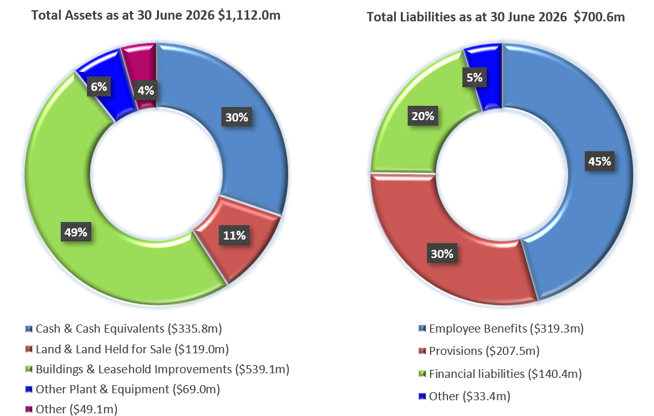
Statement of Financial Position | 2025-26 *Budget $000s | 2025-26 Actual $000s | 2025-26 Variation $000s | Past year 2024-25 $000s |
|---|---|---|---|---|
Current assets | 375 809 | 362 084 | (13 725) | 352 685 |
Non-current assets | 814 086 | 749 914 | (64 172) | 757 000 |
Total assets | 1 189 895 | 1 111 998 | (77 897) | 1 109 685 |
Current liabilities | 228 434 | 213 314 | (15 120) | 206 840 |
Non-current liabilities | 470 418 | 487 337 | 16 919 | 479 118 |
| Total liabilities | 698 852 | 700 651 | 1 799 | 685 958 |
| Net assets | 491 043 | 411 347 | (79 696) | 423 727 |
| Equity | 491 043 | 411 347 | (79 696) | 423 727 |
*The 2025-26 budget is the 2025-26 original budget that aligns to the 2025-26 State Budget Paper 4.
The following is a summary of external consultants that have been engaged by the agency, the nature of work undertaken, and the actual payments made for the work undertaken during the financial year.
Consultancies with a contract value below $10,000 each
Consultancies | Purpose | $ Actual Payment |
|---|---|---|
All consultancies below $10,000 each (combined) | Nil | 0 |
Consultancies with a contract value above $10,000 each
Consultancies | Purpose | $ Actual Payment |
|---|---|---|
BDO Services Pty Ltd | Independent review of the District Policing Model (DPM) designed to inform SAPOL on the effectiveness of the DPM policing model. | $1 121 515 |
Total | $1 121 515 | |
Data for previous years is available at: https://data.sa.gov.au/data/dataset/annual-reporting-data
See also the Consolidated Financial Report of the Department of Treasury and Finance for total value of consultancy contracts across the South Australian Public Sector.
The following is a summary of external contractors that have been engaged by the agency, the nature of work undertaken, and the actual payments made for work undertaken during the financial year.
Contractors with a contract value below $10,000
Contractors | Purpose | $ Actual Payment |
|---|---|---|
All contractors below $10,000 each - combined | Various | $3 188 |
Contractors with a contract value above $10,000 each
Contractors | Purpose | $ Actual Payment |
|---|---|---|
Access Testing Pty Ltd | Agency staff engaged for testers for e-projects | $82 850 |
| Adecco Australia Pty Ltd | Agency Staff engaged for services relating to IS&T activities | $64 108 |
AG Security Group | Private security guards sourced by Police Security Services Branch (PSSB) for existing service delivery | $43 254 |
Akkodis Australia Consulting | Agency staff engaged for services relating to IS&T activities | $270 865 |
Akkodis Australia Talent | Agency staff Services | $3 157 970 |
Alarm Monitoring Australia | Private security guards sourced by Police Security Services Branch (PSSB) for existing service delivery | $340 822 |
Chamonix It Management | Agency staff engaged for services relating to IS&T activities | $1 493 115 |
Chandler Macleod Group Ltd | Agency staff engaged to provide administrative and other services | $44 633 |
Chloe Luu Consulting | Claims Management Services | $13 725 |
Corporate Health Group Pty Ltd | Agency staff engaged to assist with the role of the Police Medical Officer | $891 176 |
DFP Recruitment Services | Agency staff engaged to provide administrative services | $950 918 |
Dialog Pty Ltd | Agency staff engaged for services relating to IS&T activities and projects | $2 732 645 |
Edge Recruitment | Agency staff engaged to provide administrative and other services | $1 212 756 |
Escient Pty Ltd | Agency staff engaged for Architecture e-projects | $632 498 |
Fragile To Agile (Asia Pac) Pty Ltd | Agency staff engaged for Architecture e-projects | $444 743 |
Halcyon Knights Australia | Agency staff engaged to provide administrative and other services | $716 470 |
| Hannan & Partners Pty Ltd | Procurement Services | $17 110 |
Harrison McMillan Pty Ltd | Agency staff engaged to provide administrative, project work and other services | $400 113 |
Hays Specialist Recruitment | Agency staff engaged to provide administrative and other services | $4 608 175 |
Hudson Global Resources (Aust) | Agency staff engaged to provide administrative services | $499 367 |
Inner Range Pty Ltd | Provision of alarm monitoring products and services | $649 657 |
| Insync Solutions Pty Ltd | Agency Staff engaged for services relating to IS&T activities | $12 838 |
James Anthony Group Pty Ltd | Agency Staff engaged for services relating to IS&T activities | $45 585 |
| Joyleen McMahon | Claims Management Services | $44 850 |
| KPMG Australia Technology | Agency Staff engaged for services relating to IS&T activities | $1 458 575 |
| NCS Pty Ltd | Agency Staff engaged for services relating to IS&T activities | $795 088 |
NRI Australia Limited | Agency staff engaged for projects | $570 756 |
Paxus Australia Pty Ltd | Agency staff engaged for services relating to IS&T activities | $4 867 252 |
Peoplebank Australia Ltd | Agency staff services | $2 260 010 |
Planit Test Management Solutions | Agency Staff engaged for services relating to IS&T activities | $180 026 |
Procurement Partners | Procurement Services | $77 103 |
Rainy Day Recruitment | Agency staff services | $167 694 |
| Randstad Digital Pty Ltd | Agency staff engaged to provide administrative, project work and other services | $63 145 |
Randstad Pty Ltd | Agency staff engaged to provide administrative, project work and other services | $2570 878 |
| Redpath Partners Pty Ltd | Agency staff services | $266 378 |
RNTT Pty Ltd | Agency staff engaged to provide administrative and other services | $31 892 |
| Robert Walters Pty Ltd | Agency staff services | $80 826 |
SafeSelect | Psychometric testing of recruitment applicants | $438 105 |
| Satalyst Pty Ltd | Agency staff services | $29 160 |
State Security & Protective Services (Aust) Pty Ltd | Private security guards sourced by Police Security Services Branch for existing service delivery | $195 260 |
Stillwell Management Consultants Pty Ltd | Agency staff engaged to assist with staff recruitment | $106 630 |
Talent International (SA) Pty Ltd | Agency staff engaged for Architecture | $827 476 |
Sub Total | $34 362 497 | |
Total | $34 365 685 | |
Data for previous years is available at: https://data.sa.gov.au/data/dataset/annual-reporting-data
The SA Tenders and Contracts website displays details of Government of South Australia-awarded contracts for goods, services and works and across government contracts.
The following reflects contracts entered into during the financial year as reported to the Department of Treasury and Finance pursuant to Treasurer’s Instructions 18 - Procurement. The information is unaudited.
Contractors entered into | 2025-26 Number of contracts | 2025-26 Contract value $000s |
|---|---|---|
With South Australian businesses | 169 | $64 209 759.65 |
With non-South Australian businesses | 122 | $31 444 243.98 |
Total | 291 | $95 654 003.63 |
Note: ‘South Australian business’ has the same meaning as in Treasurer’s Instructions 18 - Procurement.
Other information
On 17 July 2006, a previous Cabinet approved the Government Protective Security Framework and Policy that mandates Police Security Services Branch (PSSB) as the security provider for ‘designated’ SA Government assets along with a whole-of-government alarm monitoring service.
PSSB provides protective security services to South Australian Government sites including defined ‘protected places’ and critical infrastructure (including those determined to be high risk). PSSB deploys police security officers (PSOs) to perform various roles, including static security duties at government facilities, protective security patrols such as alarm response and proactive patrolling, and operates the Security Control Centre (SCC) providing a whole-of-government alarm and CCTV monitoring service on a cost recovery basis. PSSB continues to expand its operations and in 2023 the Branch added the District Support Section (DSS) to its structure in response to ongoing demand for front line police resources.
In October 2022 legislative amendments resulted in the transition of PSOs from the former Protective Security Act 2007 to the Police Act 1998. The transition changed the title of officers from ‘protective security officers’ to ‘police security officers’ to coincide with the expansion of their duties and authorities.
As of June 2026, several SA Government sites were designated as critical infrastructure-high risk (CI-HR) assets and subsequently determined by the Minister for Police and Correctional Services as needing protection pursuant to the South Australian Protective Security Framework. There are currently 21 sites determined to be protected places, eight of which are also designated as CI-HR assets.
The CI-HR assets were assessed on the basis that if they were destroyed, disrupted, degraded, harmed or rendered unavailable for an extended period there would be a significant impact on the delivery of key government services; or that the reputation of the state would be affected and there would be reduced community confidence in the SA Government’s ability to effectively conduct business. Physical security in these premises is provided by PSOs who are trained and equipped to safely manage situations. The South Australian Protective Security Framework (Physical Security) sets out the process to follow for assets designated as CI-HR, with affected agencies required to identify any resource or costing pressures through the process of Cabinet submissions to the Emergency Management Council. In 2025-26 there were no changes to the number or nature of assets determined as CI-HR.
The role of the Security Control Centre is to provide protective security services to government clients through the monitoring of electronic security devices including alarms and CCTV, coordinating an appropriate response to incidents detected, monitoring of SA Government Radio Network (SAGRN) talk groups used by SA Government clients, and raising and sending service work orders to clients for identified electronic security breakdowns.
Throughout 2025-26 PSSB’s operations continued to expand following the ongoing implementation of the DSS. When fully established the DSS will comprise 189 PSOs whose roles include security of people, places, and property. The DSS undertakes security-related duties traditionally undertaken by police officers and enables SAPOL to better manage demands for policing services.
As of 30 June 2026, there were 90 PSOs undertaking the expanded functions in DSS, comprising 55 in metropolitan police custody facilities (detained person guard services) and the remainder undertaking duties such as conveyance of detained persons between custody facilities and hospitals, guarding arrested persons in hospitals, and conveyance of Guardianship of the Chief Executive children back to care placements. Recruiting remains a priority and focus to attract and retain PSOs in order to achieve the full 189 FTE as quickly as possible.
PSSB comprises 301 FTE consisting of 279 PSOs, 12 Public Sector Act employees and 10 police officers
(as of 30 June 2026). A further three Public Sector Act employees are included in the expanded branch model (positions yet to be substantively filled).
The current PSO staffing model is outlined in the table below.
Section | Description | Level | Number | PSO TOTAL |
|---|---|---|---|---|
Protective Security Section | Police security officer sergeants | OPS5 | 7 | 125 |
| Senior police security officers | OPS4 | 7 | ||
Police security officers | OPS3 | 111 | ||
Security Control Centre | Senior police security officers | OPS4 | 5 | 28 |
Police security officers | OPS3 | 23 | ||
District Support Section | Police security officer sergeants | OPS5 | 5 | 90 |
Senior police security officers | OPS3 | 5 | ||
Police Security Officers | OPS2 | 80 | ||
Other | Recruits in training, long-term absent (injured, Maternity Leave etc.), seconded to Academy, temporarily restricted | Various | 36 | 36 |
Over the past financial year, there has been 55 incidents at designated CI-HR sites. Of these, five resulted in the detention of a person. Forty two incidents at CI-HR sites were of a minor nature (for example, not resulting in the detention of a person).
There were a further 32 incidents at protected places where PSOs exercised their authorities, such as a lawful direction to provide identification, conducting a search, refusing entry and or the trespassing of a person from a site. A continued focus on tactical communications to de-escalate incidents rather than use of authorities has resulted in similar data compared with the previous financial year.
Data for previous years is available at:
https://data.sa.gov.au/data/dataset/annual-reporting-data
Reports of alleged potential corruption within the South Australian public sector are received by SAPOL’s Anti-Corruption Section (ACS) from a variety of sources including the Office for Public Integrity (OPI), Independent Commission Against Corruption (ICAC), the Australian Criminal Intelligence Commission (ACIC), the Crown Solicitors Office, SAPOL’s Internal Investigation Section, Crime Stoppers, police officers, members of the public, and from information provided pursuant to the requirements of the Public Interest Disclosure Act 2018 (SA).
| Type of Investigation | 2025-26 |
|---|---|
| ACS Investigation | 173 |
| ACS/ICAC Joint Investigation | 2 |
In the ordinary course of business, ACS may conduct an initial investigation to assess information to determine whether there is a reasonable suspicion of corruption, or of serious or systemic misconduct or maladministration. Where such a suspicion is subsequently formed the matter is reported to OPI.
In many cases, matters may be ‘filed’ following initial assessment/investigation, where there is no reasonable suspicion of corruption and no supporting evidence to warrant further enquiries into the information. Where an offence is detected which is not corruption these matters are referred by ACS to the relevant investigation area within SAPOL.
Where ICAC or OPI have referred a matter to SAPOL to conduct an investigation, the Officer in Charge, ACS (or delegate) will determine whether the investigation is to be conducted by ACS or sent to another investigation area within SAPOL. In certain circumstances, ACS may commence an investigation into a matter however, will advise OPI of the investigation in accordance with its reporting obligations.
The Independent Commission Against Corruption Act 2012 (SA) changed significantly in October 2021. As a result of these changes, ICAC is no longer able to refer matters to the Director of Public Prosecutions for prosecution and must instead refer a matter to a law enforcement agency for further investigation and/or prosecution. The legal definition of corruption was also amended and now limits the type of offences the ICAC has the ability to investigate and then refer to SAPOL. In March 2024 ACS engaged four investigation support officers to assist with this ICAC workload resulting from the changes to the Act.
It should be noted from time to time the Australian Commission for Law Enforcement Integrity (ACLEI) may also direct joint investigations with ACS pursuant to the Law Enforcement Integrity Commissioner Act 2006 (Cth). No joint ACS/ACLEI investigations were commenced during this reporting period.
The breakdown of total ACS investigations managed during 2025-26 is recorded below:
| Type of Investigation | 2025-26 |
|---|---|
| Miscellaneous Assessment | 0 |
| ACS Operations | 156 |
| Investigations referred SAPOL area (not retained at ACS) | 17 |
| ICAC Trials managed by ACS (due to legislative change) | 7 |
A breakdown of the category of the ‘public official’ alleged to have been involved in a potential issue of corruption in public administration is depicted below (as far as can be determined). Where a matter has allegedly involved more than one nominated ‘suspect’, the ‘public official’ status of the primary suspect is recorded.
| Type of Investigation | 2025-26 |
|---|---|
| SAPOL Police Officer - sworn (including Community Constables) | 61 |
| SAPOL - unsworn/cadet | 4 |
| Protective Security | 2 |
| Other SA Public Sector/ State Government | 82 |
| Local Government | 16 |
| Other (includes civilians) | 9 |
| Commonwealth Public Sector | 1 |
Data for previous years is available at: https://data.sa.gov.au/data/dataset/annual-reporting-data
Risk management
The SAPOL Risk and Performance Committee provide independent advice and assurance to the Commissioner of Police, to assist in discharging his responsibilities as they relate to SAPOL’s Risk and Assurance framework.
The Committee comprises SAPOL Executives and two independent external subject matter professionals that enhance transparency and external oversight. The Committee oversees and provides advice on matters of accountability and internal controls affecting the operations of SAPOL, ensuring corporate risks have been identified and addressed, while fostering an ethical and accountable environment within SAPOL.
During 2025-26 the Committee convened on five occasions.
Category/nature of fraud | Number of instances |
|---|---|
Theft by Deception (fraud) offences | 0 |
NB: Fraud reported includes actual and reasonably suspected incidents of fraud.
SAPOL has numerous processes and controls in place to prevent, identify and respond to fraud. These include SAPOL’s Fraud & Corruption Control Plan, the Financial Management Compliance Program, together with a rigorous internal audit program, monthly management reports, controlled self-assessments and risk management framework.
Further controls include (but are not limited to) policies relating to authorisations (human resources, purchase, authority to sign contracts, expenditure), segregation of duties, asset stock-takes, conflict of interest and code of conduct policies, reconciliations, access to transaction details and financial processing limits.
Periodic audits are conducted at Service level that test the various controls in place. A strategic three year rolling plan has scheduled independent financial audits, which further test the effectiveness of internal controls for potential misstatements and the detection of fraud. This is further supported by external audit activities undertaken by the Audit Office of South Australia that provides reasonable assurance and an opinion on SAPOL’s collective financial controls.
SAPOL has numerous avenues established to support the reporting of alleged potential or actual fraud by employees or community through the Internal Investigation Section and other government agencies including the Office for Public Integrity, Independent Commission Against Corruption, the Australian Criminal Intelligence Commission, the Crown Solicitors Office and Crime Stoppers.
Data for previous years is available at:
https://data.sa.gov.au/data/dataset/annual-reporting-data
Number of occasions on which public interest information has been disclosed to a responsible officer of the agency under the Public Interest Disclosure Act 2018 (SA):
24
Data for previous years is available at:
https://data.sa.gov.au/data/dataset/annual-reporting-data
Note: Disclosure of public interest information was previously reported under the Whistleblowers Protection Act 1993, which was repealed by the Public Interest Disclosure Act 2018 on 1 July 2019.
Reporting required under any other act or regulation
Act or Regulation | Requirement |
|---|---|
Controlled Substances Act 1984 | Section 52C(1) The Commissioner of Police must, on or before 30 September in each year (other than the calendar year in which this section becomes into operation), provide a report to the Attorney-General specifying the following information in relation to the financial year ending on the preceding 30 June: (a) the number of authorisations granted by senior police officers under sections 52A and 52B during that financial year; (b) the public places or areas in relation to which those authorisations were granted; (c) the periods during which the authorisations applied; |
For the period 1 July 2025 to 30 June 2026:
General Drug Detection Powers - Section 52A(3)
A senior police officer may authorise the exercise of powers under this section in relation to a public place. There were 47 authorisations granted by senior police officers pursuant to section 52A.
This authorisation enabled drug detection powers to be exercised in a defined area for specified periods that do not exceed 14 days. No authorisation exceeded the 14-day limit.
Data for previous years is available at https://data.sa.gov.au/data/dataset/annual-reporting-data.
Location | Number of authorisations | Specific Period/s Authorisation Applied |
|---|---|---|
Westfield Marion, Marion | 10 | 0700 10/07/25 – 2200 10/07/25 0700 11/09/25 – 2200 11/09/25 1600 02/10/25 – 1900 02/10/25 0700 09/10/25 – 2200 09/10/25 1600 30/10/25 – 1900 30/10/25 1600 11/12/25 – 1900 11/12/25 0700 18/12/25 – 2200 31/12/25 1500 14/05/26 – 1900 14/05/26 1000 29/05/26 – 1500 29/05/26 1600 11/06/26 – 1900 11/06/26 |
Victor Harbor CBD, Victor Harbor | 1 | 0800 21/11/25 – 0600 24/11/25 |
Elizabeth City Centre, Elizabeth | 3 | 1800 07/08/25 – 2330 07/08/25 1700 11/09/25 – 2230 11/09/25 1600 25/09/25 – 2230 25/09/25 |
Colonnades Shopping Centre, Noarlunga | 9 | 1000 21/07/25 – 1800 21/07/25 1700 21/08/25 – 2100 21/08/25 1700 25/09/25 – 2100 25/09/25 1000 14/10/25 – 1800 14/10/25 1000 18/11/25 – 1800 18/11/25 1000 23/12/25 – 1800 23/12/25 1000 29/01/26 – 1800 29/01/26 0900 17/03/26 – 2100 17/03/26 1200 26/03/26 – 1400 26/03/26 |
Smithfield Memorial Gardens, Smithfield | 2 | 0001 01/06/26 – 2359 14/06/26 0001 15/06/26 – 2359 28/06/26 |
Port Augusta CBD, Port Augusta | 1 | 1200 23/01/26 – 1900 30/01/26 |
Adelaide CBD Entertainment Precinct, Adelaide | 1 | 1800 12/07/25 – 0200 13/07/25 |
Torrens Road, Brompton/Ovingham | 1 | 1600 16/09/25 – 1600 20/09/25 |
Arndale Shopping Centre, Kilkenny | 4 | 1600 21/07/25 – 1900 21/07/25 0900 06/11/25 – 0900 19/11/25 0900 09/12/25 – 0900 23/12/25 0900 09/01/26 – 0900 23/01/26 |
West Lakes Shopping Precinct, West Lakes | 1 | 1600 18/09/25 – 1900 18/09/25 |
Cedun CBD, Ceduna | 1 | 1100 04/10/25 – 1100 06/10/25 |
Aldinga Shopping Centre, Aldinga | 1 | 1030 07/10/25 – 1900 08/10/25 |
Bonython Park, Port Rd, Adelaide | 1 | 1330 06/12/25 – 2359 06/12/25 |
Dockyard, Largs North | 1 | 1700 31/10/25 – 2100 31/10/25 |
Castle Plaza, Edwardstown | 2 | 1200 12/11/25 – 1330 12/11/25 0700 23/01/26 – 1700 23/01/26 |
Mannum Golf Club, Mannum | 1 | 1100 22/11/25 – 2359 22/11/25 |
Rymill Park, Adelaide | 1 | 1400 06/02/26 – 2000 06/02/26 |
Streaky Bay Community Complex, Streak Bay | 1 | 1030 08/03/26 – 0200 09/03/26 |
Adelaide Showgrounds, Wayville | 1 | 1200 14/02/26 – 2000 14/02/26 |
| Currie Street, Adelaide | 1 | 1800 21/03/26 – 0300 22/03/26 |
Waymouth Street, Adelaide | 1 | 1800 21/03/26 – 0300 22/03/26 |
Crittenden Road, Findon (36ers Stadium) | 1 | 1500 06/06/26 – 2330 06/06/26 |
Westland Shopping Centre/Civic Park, Whyalla | 1 | 1400 23/01/26 – 1900 30/01/26 |
Drug Transit Route Deployments - Section 52B(1)
There were 10 authorisations granted by senior police officer’s for identified drug transit routes pursuant to section 52B(1).
This authorisation enabled drug detection powers to be exercised in a defined area for specified periods that do not exceed 14 days. Nil authorisations exceeded the 14-day limit.
Location | Number of authorisations | Specific Period/s Authorisation Applied |
|---|---|---|
Augusta Hwy/Princess Hwy, Port Augusta/Stirling North | 1 | 1000 28/08/25 – 2200 29/08/25 |
Sturt Hwy, Yamba | 1 | 1000 28/11/25 – 2100 28/11/25 |
Stuart Hwy, Shea-Oak Log | 1 | 0001 13/10/25 – 2329 13/10/25 |
Barrier Hwy, Oodla Wirra | 1 | 2100 03/09/25 – 0900 04/09/25 |
Stuart Hwy, Marla | 1 | 1800 25/03/26 – 0030 27/03/26 |
Dukes Hwy, Keith | 1 | 1000 28/11/25 – 2100 28/11/25 |
Eyre Hwy, Ceduna | 1 | 1030 03/10/25 – 2330 03/10/25 |
Lincoln Hwy, Cowell | 1 | 0001 05/03/26 – 2359 05/03/26 |
Augusta Hwy, Warnertown | 2 | 2100 04/09/25 – 0900 05/09/25 0900 06/03/26 – 1600 06/03/26 |
Overall, there were 509 deployments where teams operated under section 52A Controlled Substances Act 1984 (CSA), including under section 66S Summary Offences Act 1953 (SOA), and section 52B in the following areas:
Deployments | 2025-26 |
|---|---|
Section 52A(2)(a) (CSA) - Licensed Premises | 228 |
Section 52A(2)(b) (CSA) - Public Venues | 1 |
Section 52A(2)(c) (CSA) - Public Passenger Carrier | 189 |
Section 52A(2)(d) (CSA) - Public Place | 61 |
Section 52B(1) (CSA) - Drug Transit Route | 13 |
Section 66S (SOA) - Declared Public Precinct (52A) | 17 |
TOTAL | 509 |
There were 2 386 indications of the presence of a controlled drug, controlled pre-cursor or controlled plant during the exercise of powers under sections 52A(2)(a), 52A(2)(b), 52A(2)(c), 52A(2)(d) and 52B(1) CSA, including 66S SOA provisions.
From these 2 386 indications there were 400 detections, 1 466 ‘residual admits’ and 520 ‘residual denies’. As a result of the 400 detections, there were 511 arrest/reports, drug diversion and/or cannabis expiation notices initiated.
Total seizures during the Passive Alert Detector Dog (PADD) deployments under section 52A and section 52B were 183.7 grams of ecstasy, approximately 1.5 kilograms of cannabis, 96.7 grams of amphetamine, 45 grams of cocaine, 1 gram of heroin, 69.2 grams of other substances and 163 pieces of drug paraphernalia/equipment.
Data for previous years is available at: https://data.sa.gov.au/data/dataset/annual-reporting-data
Act or Regulation | Requirement |
|---|---|
Evidence Act 1929 (SA) | Section 49 (8) A report under subsection (7) may be incorporated in any other annual report that the Commissioner of Police or the Corporate Affairs Commission (as the case may be) is required by or under statute to make to the Minister to whom the report under that subsection is to be submitted. |
Power to Order Inspection of Banking Records - Section 49(1a)
There were 634 applications made by members of the police force pursuant to section 49(1a) of the Act for the period 1 July 2025 to 30 June 2026.
Data for previous years is available at: https://data.sa.gov.au/data/dataset/annual-reporting-data
Act or Regulation | Requirement |
|---|---|
Hydroponics Industry Control Act 2009 (SA) | Section 34(1) The Commissioner must, on or before 31 October in each year, submit to the Minister a report on the administration of this Act during the period of 12 months ending on the preceding 30 June. |
For the period 1 July 2025 to 30 June 2026:
Hydroponics Industry Control Act and Regulations | 2023-24 |
|---|---|
Apprehension reports | 0 |
Offences | 0 |
Expiations | 0 |
Number of applications received for Hydroponics Equipment Dealer’s Licence | 0 |
Number of applications received for approval of Hydroponics Industry Employees | 0 |
Number of applications received seeking a Ministerial Exemption from the Act | 0 |
For the purpose of this Act, a person will be taken to be carrying on the business of selling prescribed equipment by retail.
Data for previous years is available at: https://data.sa.gov.au/data/dataset/annual-reporting-data
Act or Regulation | Requirement |
|---|---|
Liquor Licensing Act 1997 (SA) | Section 128AB The Commissioner of Police must include in the Commissioner of Police’s report to the Minister responsible for the administration of the Police Act 1998 the following information in respect of each order made under Subdivision 3 in the financial year to which the report relates because of information classified by the Commissioner of Police as criminal intelligence: (a) the number of orders made; (ii) the age, gender, race and residential postcode of the persons barred. |
Barring Orders - Section 128AB
There were no orders made pursuant to section 128AB of the Liquor Licensing Act 1997 for the period 1 July 2025 to 30 June 2026.
Data for previous years is available at: https://data.sa.gov.au/data/dataset/annual-reporting-data
Act or Regulation | Requirement |
|---|---|
Liquor Licensing Act 1997 (SA) | Section 128C(8) The Commissioner of Police must include in his or her annual report to the Minister to whom the administration of the Police Act 1998 is for the time being committed a record of - (a) the number of orders made under this section during the period to which the report relates; and (ii) the period for which the order was in force; and (iii) the grounds on which the order was made; and (c) any other matters the Commissioner of Police considers relevant. |
Power of Police to Clear or Close Licensed Premises - Section 128C
This report refers to orders made by Senior Police Officers to clear or close licensed premises deemed unsafe because of prevailing conditions at the premises.
There were no orders made pursuant to section 128C(8) of the Liquor Licensing Act 1997 for the period 1 July 2025 to 30 June 2026.
Data for previous years is available at: https://data.sa.gov.au/data/dataset/annual-reporting-data
Act or Regulation | Requirement |
|---|---|
Road Traffic Act 1961 (SA) | Section 47E(8) The Commissioner of Police must, in the Commissioner’s annual report to the Minister responsible for the administration of the Police Act 1998, include the numbers of drivers required to submit to an alcotest in the course of the exercise of random testing powers (otherwise than at breath testing stations established in accordance with section 47DA). |
Alcotest or Breath Analysis - Section 47E
There was a total of 520 587 driver screening tests conducted for the period of 1 July 2025 to 30 June 2026.
Of those, pursuant to section 47E there were 136 437 mobile driver screening tests conducted.
Data for previous years is available at: https://data.sa.gov.au/data/dataset/annual-reporting-data
Act or Regulation | Requirement |
|---|---|
Shop Theft (Alternative Enforcement) Act 2000 (SA) | Section 18 (1) The Commissioner of Police must, on or before 30 September in each year, prepare a report on the operation and administration of this Act during the period of 12 months that ended on the preceding 30 June. (2) A report required under this section must be incorporated in the annual report of the Commissioner of Police required under the Police Act 1998. |
For the period 1 July 2025 to 30 June 2026:
Shop Theft Infringement Notices (STIN) | 2025-26 |
|---|---|
STIN 1 issued | 0 |
STIN 1 completed | 0 |
STIN 2 issued | 0 |
STIN 2 completed | 0 |
Withdrawal of Consent (PD259) | 0 |
Community service hours for STIN 2 offence | 0 |
Apologies required for STIN 1 offence | 0 |
Apologies required for STIN 2 offence | 0 |
Apprehension Reports for breach | 0 |
Apprehension Reports for subsequent breach | 0 |
Data for the previous years is available at: https://data.sa.gov.au/data/dataset/annual-reporting-data
Act or Regulation | Requirement |
|---|---|
Summary Offences Act 1953 (SA) | Section 21K The following information must be included in the annual report of the Commissioner under section 75 of the Police Act 1998 (other than in the year in which this section comes into operation): (a) the number of weapons prohibition orders issued under section 21H; |
For the period 1 July 2025 to 30 June 2026:
Weapons Prohibition Orders | 2025-26 |
|---|---|
Number of weapons prohibition orders issued under section 21H | 5 |
Number of weapons prohibition orders revoked under section 21H | 0 |
Number of appeals under section 21J and the outcome of each appeal that has been completed or finally determined | 0 |
Breaches of Weapons Prohibition Orders | 5 |
Data for previous years is available at: https://data.sa.gov.au/data/dataset/annual-reporting-data
Act or Regulation | Requirement |
|---|---|
Summary Offences Act 1953 (SA) | Section 66ZK The following information must be included in the annual report of the Commissioner under section 75 of the Police Act 1998 (other than in the year in which this section comes into operation) in respect of the period to which the report relates (the relevant period) (a) the number of declarations made under this Part during the relevant period; (ii) the number of people searched in the exercise of powers under the relevant section; and (iii) whether weapons or articles of a kind referred to in Part 3A were detected in the course of the exercise of powers under this section; and (iv) the types of weapons or articles so detected; and (v) in relations to an authorisation granted under section 66Y - whether the Commissioner gave consent under section 66Y(3); (h) any other information requested by the Minister. |
For the period 1 July 2025 to 30 June 2026:
Metal Detector Searches | *2025-26 |
|---|---|
Number of declarations made under this Part | 29 |
Number of declarations revoked under this Part | 0 |
Number of declarations in force at the end of the relevant period | **26 |
Number of metal detector searches carried out under this Part | 12 368 |
Number of occasions on which a metal detector search carried out indicated the presence, or likely presence, of any metal | 6 212 |
Number of occasions on which weapons or articles of a kind referred to in Part 3A were detected in the course of such searches | ***81 |
* On 12 March 2025, S66ZK of the Summary Offences Act 1953 was enacted, expanding the powers previously held under S72A and S72B of the Summary Offences Act 1953 and introducing new reporting requirements. These changes are reflected for the first time in this report.
**As at 30 June 2026 the Commissioner remains satisfied that the criteria in respect of these declarations still applies.
***Weapon types include folding knife, multitool knife, pocket knife, box cutter, flick knife, hammer, axe, knuckle duster, glass breaker tool, extendable baton, adapted spanner, scissors.
Special Search Powers to Prevent Serious Violence - Section 66Y
There were no authorisations under section 66Y where Special Search Powers to Prevent Serious Violence were granted in the reporting period of 1 July 2025 to 30 June 2026.
Power to Conduct Metal Detector Searches to Prevent Violence or Disorder in Certain Public Places – Section 66Z
There were no authorisations under section 66Z where Power to Conduct Metal Detector Searches to Prevent Violence or Disorder in Certain Public Places were granted in the reporting period of 1 July 2025 to 30 June 2026.
Data for previous years is available at: https://data.sa.gov.au/data/dataset/annual-reporting-data
Act or Regulation | Requirement |
|---|---|
Summary Offences Act 1953 (SA) | Section 72F The following information must be included in the annual report of the Commissioner under section 75 of the Police Act 1998 (other than in the year in which this section comes into operation): a) the number of occasions on which the search powers under section 72D were exercised during the period to which the report relates; and |
For the period 1 July 2025 to 30 June 2026:
This report refers to the number of occasions a police officer has exercised search powers under Section 72D for the purpose of ascertaining whether a suspected explosives offence is being or has been committed.
Explosive Powers | 2025-26 |
|---|---|
Searches section 72D | 20 |
Number of times property seized for searches section 72D | 19 |
Persons charged with explosives offences section 72D | 8 |
Nature of Property Seized 72D | 2025-26 |
|---|---|
Explosives - Commercial | 9 |
Explosives - Home Made | 10 |
Explosives - Incendiary | 4 |
Explosives - Precursor | 5 |
Explosives - Equipment | 2 |
Explosives - Explosive Device | 13 |
Explosives - Incendiary Device | 3 |
Data for previous years is available at: https://data.sa.gov.au/data/dataset/annual-reporting-data
Act or Regulation | Requirement |
|---|---|
Summary Offences Act 1953 (SA) | Section 83C (6) The Commissioner must, as soon as practicable (but not later than three months) after each 30 June, submit a report to the Minister in relation to the year ended on that 30 June stating - (a) the number of authorisations and warrants granted under this section during that year; |
The number of forced entries for the reporting period of 1 July 2025 to 30 June 2026 included:
Special Powers of Entry | 2025-26 |
|---|---|
No. of authorisations issued* | 220 |
Grounds for issue of authorisations | |
|---|---|
Deceased person believed in premises section 83C(1)(a) | 71 |
Person in premises requiring medical assistance section 83C(1)(b) | 149 |
Information reported | |
|---|---|
Deceased | 76 |
Attempt suicide / person detained (Mental Health Act)** | 20 |
Drug / Alcohol Overdose | 5 |
Concern occupant deceased | 11 |
Premises empty / unoccupied | 38 |
Medical / other assistance not specified | 29 |
No medical attention required | 27 |
Missing person - welfare grounds | 4 |
Authority not used - not required*** | 10 |
*Authorisations above were issued after concerned relatives or friends contacted police anxious about the welfare of a person who had not been seen for some time.
**Includes threats of suicide.
***Includes premises not entered.
Special Powers of Entry | 2025-26 |
|---|---|
Grounds for issue of warrants:* | |
Searching the premises for material that might assist in identifying the deceased or relatives of the deceased, section 83C(3)(a) | 1 |
Take property of the deceased into safe custody, section 83C(3)(b) | 1 |
*Property taken pursuant to warrants includes: medication and electronic devices.
Data for previous years is available at: https://data.sa.gov.au/data/dataset/annual-reporting-data
Act or Regulation | Requirement |
|---|---|
Summary Offences Act 1953 (SA) | Section 83BA(9) The Commissioner must include in the Commissioner's annual report to the Minister to whom the administration of the Police Act 1998 is for the time being committed a record of the authorisations issued under subsection (7) during the period to which the report relates. |
Overcrowding at Public Venues - Section 83BA
There were no authorisations issued pursuant to section 83BA of the Summary Offences Act 1953 relating to the overcrowding at public venues for the period 1 July 2025 to 30 June 2026.
Data for previous years is available at: https://data.sa.gov.au/data/dataset/annual-reporting-data
Section 6 of the Carers Recognition Act 2005 (SA) requires SAPOL to take all practicable measures to ensure that the organisation and its officers, employees or agents have an awareness and understanding of the Carers Charter and take action to reflect the principles of the Charter in the provision of the relevant services of that organisation.
In addition, SAPOL must consult carers, or persons or bodies that represent carers, in policy or program development; or strategic or operational planning, relevant to carers and the persons they care for.
Awareness: There is a system to ensure all management, staff and volunteers have an understanding of the Carers Charter. |
|---|
In October 2025 SAPOL promoted National Carers Week, with the theme “Millions of Reasons to Care”. Awareness of the week and recognition of those employees and volunteers who are carers was raised via an all-staff email and intranet notice. The email included links to information on the South Australian Carers Recognition Act 2005 (the Act) and the SA Carers Charter; SAPOL’s Health, Safety and Wellbeing Branch; SAPOL’s Disability Access and Inclusion Plan 2020-2024 (DAIP) and SAPOL’s Diversity and Inclusion Strategy 2021-2025; and to further information available on the Department of Human Services website.
SAPOL provides disability awareness training which contains information on the Carers Charter and the Act, and the DAIP. This training forms part of the induction program for new employees. It also serves to assist employees to understand and respond appropriately to the needs of people with a disability. SAPOL’s Constable Development Program and the Promotional Qualification Framework also incorporate disability management training. |
Consultation: There is a system to ensure consultation with carers, or persons or bodies that represent carers, in the development and review of human resource plans, policies and procedures. |
|---|
Consultation was a key component of the development of SAPOL’s Disability Access and Inclusion Plan 2026-2030 (DAIP). The plan was published in June 2026. Diversity and Inclusion Branch are a central point for employees to raise issues, provide feedback or suggestions in relation to policies and procedures which affect people living with disability or carers. |
Practice: There is a system to ensure the principles of the Carers Charter are reflected in human resource practice. |
|---|
SAPOL’s People Strategy 2021-2025, Diversity and Inclusion Strategy 2021-2025 and DAIP affirm SAPOL’s commitment to being a diverse and inclusive organisation. This commitment supports the principles of the Carers Charter. New versions of the People Strategy and the Diversity and Inclusion Strategy are currently under development and will continue SAPOL’s commitment to being a diverse and inclusive organisation. SAPOL supports flexible work to assist employees in achieving some balance between work and other responsibilities (including those as a carer). There is a dedicated flexible work team and a comprehensive intranet site to assist employees in their application for flexible work. With clear policies, resources and a dedicated team there is greater awareness, understanding and acceptance of flexible work. SAPOL’s Employee Assistance Section provides counselling support to all employees for a range of reasons when sought, including issues relating to relationships, stress management and work difficulties. An external Employee Assistance Program is also available to employees on issues that impact on their wellbeing. |
During 2025-26, SAPOL commenced implementation activities to support the objectives of Premier and Cabinet Circular 007 (PC007) Climate Ready Government and continued to deliver sustainability programs in facilities and project works across the statewide asset portfolio.
SAPOL also undertook an information sharing and benchmarking exercise through Australian and New Zealand Policing Advisory Agency (ANZPAA) to better understand climate readiness approaches across Australian and New Zealand policing jurisdictions, including opportunities, challenges, risks and operational considerations associated with both infrastructure and frontline policing functions. These activities are informing the development of SAPOL's approach to climate risk management, emissions reduction and organisational resilience.
2025-26 Sustainability and Climate Change Outcomes
During 2025-26, SAPOL delivered a range of infrastructure and asset management initiatives that contributed to sustainability, climate resilience and emissions reduction outcomes across the organisation. These included:
Gepps Cross Band Facilities
- Completed during 2025-26, this new construction project incorporated energy-efficient building services, LED lighting and indoor environmental quality initiatives to support operational sustainability and staff wellbeing.
LED Multi-facility Lighting Upgrade Program
- LED lighting replacements were completed at 10 metropolitan and regional facilities to support reduced electricity consumption, improve energy efficiency and lower ongoing maintenance.
- Additional LED upgrades to SAPOL’s building portfolio were delivered through routine maintenance, refurbishment and replacement activities.
Two Wells Police Station Refurbishment
- Installation of energy-efficient LED lighting, a new heating, ventilation, and air conditioning (HVAC) system to improve fresh air circulation.
- Rainwater harvesting infrastructure connected to irrigation systems.
- Native landscaping designed to reduce irrigation demand and support biodiversity.
Air Conditioning Renewal Program
- Replacement and upgrade works undertaken across approximately 20 operational facilities, improving energy performance, reliability and occupant comfort through renewal of ageing assets.
PC007 Climate Ready Government Implementation
- Key activities included executive leadership engagement, establishment of governance arrangements, identification of training and resource requirements, commencement of utility data reporting and review processes, and development of SAPOL's broader climate readiness framework.
Current Operational and Project Initiatives Supporting Sustainability and Climate Change
In addition to projects completed during the reporting period, SAPOL continued to progress a range of operational, infrastructure and strategic initiatives that support sustainability, climate readiness and long-term emissions reduction objectives. These included:
South Australia Forensic Centre (SAFC) Project
- SAPOL continued design development activities for the construction of the joint-agency South Australia Forensic Centre (SAFC) with the Attorney-General's Department during 2025-26, including developing the project's Sustainability Framework through the design process.
- The proposed design incorporates an all-electric building approach, energy reduction measures targeting an estimated 27% reduction in energy consumption compared with a reference building, water efficiency initiatives, climate resilience measures, circular economy principles and electric vehicle charging infrastructure.
- Sustainability outcomes will continue to be refined and validated throughout the detailed design, procurement and delivery phases of the project.
Fleet Diversification
- SAPOL continues to transition towards smaller-capacity, fuel-efficient and hybrid vehicles where operationally suitable.
- As at 30 June 2026, hybrid vehicles represent more than 18.9% of the General Duties and Administrative fleet, with four-cylinder vehicles comprising approximately 79% of the fleet.
- Fleet renewal initiatives have contributed to an estimated reduction of approximately 500,000 litres of fuel consumption annually while maintaining operational capability.
Electric Vehicle Trial and Charging Infrastructure
- SAPOL maintains electric vehicles within its corporate headquarters fleet to support evaluation of emerging vehicle technologies and future fleet transition opportunities.
- Electric vehicle charging infrastructure is also incorporated into new facility/major accommodation projects where appropriate.
Sustainable Asset Management
- Environmentally Sustainable Design principles continue to be incorporated into accommodation projects and asset renewal activities, including energy-efficient lighting, HVAC upgrades, rainwater harvesting, sustainable landscaping, circular economy initiatives and opportunities for future electrification of building infrastructure.
- SAPOL is progressing strategic asset planning and lifecycle management activities to inform future asset replacement programs across the built asset portfolio. These programs aim to improve asset reliability, operational resilience, energy performance and whole-of-life value, while supporting emissions reduction and climate readiness objectives.
Government Implementation
- SAPOL will continue to progress implementation of Premier and Cabinet Circular 007 (PC007) Climate Ready Government requirements, including further development of utility monitoring, emissions reporting, climate risk assessment, broader organisational climate readiness initiatives and governance processes.
- Lessons learned, strategies and emerging risks identified through ANZPAA climate readiness benchmarking will continue to inform SAPOL's developing approach to climate risk management, emissions reduction, organisational resilience and future reporting requirements.
Public complaints
Complaint categories | Sub-categories | Example | Number of Complaints 2025-26 |
|---|---|---|---|
Professional behaviour | Staff attitude | Failure to demonstrate values such as empathy, respect, fairness, courtesy, extra mile; cultural competency | 17 |
Professional behaviour | Staff competency | Failure to action service request; poorly informed decisions; incorrect or incomplete service provided | 771 |
Professional behaviour | Staff knowledge | Lack of service specific knowledge; incomplete or out-of-date knowledge | 0 |
Communication | Communication quality | Inadequate, delayed or absent communication with customer | 0 |
Communication | Confidentiality | Customer’s confidentiality or privacy not respected; information shared incorrectly | 66 |
Service delivery | Systems/technology | System offline; inaccessible to customer; incorrect result/information provided; poor system design | 0 |
Service delivery | Access to services | Service difficult to find; location poor; facilities/ environment poor standard; not accessible to customers with disabilities | 8 |
Service delivery | Process | Processing error; incorrect process used; delay in processing application; process not customer responsive | 0 |
Policy | Policy application | Incorrect policy interpretation; incorrect policy applied; conflicting policy advice given | 0 |
Policy | Policy content | Policy content difficult to understand; policy unreasonable or disadvantages customer | 0 |
Service quality | Information | Incorrect, incomplete, out-dated or inadequate information; not fit for purpose | 0 |
Service quality | Access to information | Information difficult to understand, hard to find or difficult to use; not plain English | 0 |
Service quality | Timeliness | Lack of staff punctuality; excessive waiting times (outside of service standard); timelines not met | 305 |
Service quality | Safety | Maintenance; personal or family safety; duty of care not shown; poor security service/ premises; poor cleanliness | 0 |
Service quality | Service responsiveness | Service design doesn’t meet customer needs; poor service fit with customer expectations | 987 |
No case to answer | No case to answer | Third party; customer misunderstanding; redirected to another agency; insufficient information to investigate | 0 |
Total | *2154 | ||
* Excludes 87 complaints still under assessment and not categorised at the time of reporting.
Additional Metrics | Total |
|---|---|
% complaints resolved within policy timeframes | 100% |
Data for previous years is available at: https://data.sa.gov.au/data/dataset/annual-reporting-data
Service Improvements resulting from complaints or consumer suggestions over 2025-26 |
|---|
Review of Early Sanction Model (ESM) Transforming Data Management and Intelligence Capability Through the development of structured operating procedures, improved data governance, standardised reporting practices and enhanced knowledge management, the role has increased organisational resilience, reduced key-person risk and improved the integrity of IAPro and BlueTeam data. In addition, the position has expanded EPSB’s capacity to deliver timely corporate reporting, identify emerging trends and risks, and support evidence-based decision-making through enhanced analytical products. Collectively, these improvements have increased operational efficiency, strengthened business continuity and positioned EPSB to better support both current and future organisational priorities. Enhancing Complaint Management, Reporting and Investigative Capability Through the IAPro Version 9 Upgrade The upgraded system supports more detailed and flexible data capture, including the ability to record multiple complaint classifications against a single incident, providing a more accurate representation of complaint complexity and improving the quality of statistical reporting. Enhanced customisation features streamlined navigation and improved integration with BlueTeam have increased operational efficiency and supported more effective case management processes. In addition, the upgrade has expanded reporting and analytical capabilities, enabling greater visibility of trends, risks and operational performance. These improvements have enhanced data quality, strengthened EPSB business processes and increased ability to support evidence-based decision-making and organisational reporting requirements. |
South Australia Police is compliant with Premier and Cabinet Circular 039 (PC039) Complaint Management in the South Australian Public Sector | Yes |
South Australia Police has communicated the content of PC039 and the agency’s related complaints policies and procedures to employees | Yes |