Annual Report 2024-25
This annual report will be presented to Parliament to meet the statutory reporting requirements of (Police Act 1998, Police Regulations 2014 and the Public Sector Act 2009) and the requirements of Premier and Cabinet Circular PC013 Annual Reporting.
This report is verified to be accurate for the purposes of annual reporting to the Parliament of South Australia.
Submitted on behalf of the South Australia Police by:
Grant Stevens APM LEM
Commissioner of Police
From the Chief Executive

It has now been ten years since I was given the privilege of leading the South Australian Police Force as Commissioner. I continue to have enormous pride in all our police and support staff that together make up our dedicated, professional and committed workforce.
Over the last few years, significant societal disruption has presented us with different operational challenges, that have underpinned our resilience and flexibility as an organisation to respond to the needs of our community.
We have taken the approach of focusing on what matters most and finding efficiencies to address increasing demand for police services. Equally the integration of new technology now available to law enforcement is helping to address resource limitations and assisting in the response to evolving crimes and societal change.
Throughout 2024-25 SAPOL has continued working constructively with government on the major issues of organisational concern, such as resourcing and budget constraints; and recruiting and retention challenges.
This work will continue in the next reporting period, with our key focus on attracting talented and high-achieving people into a policing career through our multi-faceted recruitment strategy which includes our inaugural ‘Pathways to Policing’ course. SAPOL has also pro-actively targeted experienced interstate and international police candidates, primarily in the United Kingdom, Republic of Ireland, New Zealand and Canada.
One major change occurred in September 2024 when SAPOL vacated the historic Thebarton Barracks. This ended a significant era for us, after more than 100 years of use of the Barracks. Sentimentality aside, the closure has led to new police facilities including a state-of-the-art Gepps Cross Police Complex for Mounted and Dog Operations Units, a purpose-built city staging facility and the Road Safety Centre at West Beach, along with new homes for several other business units.
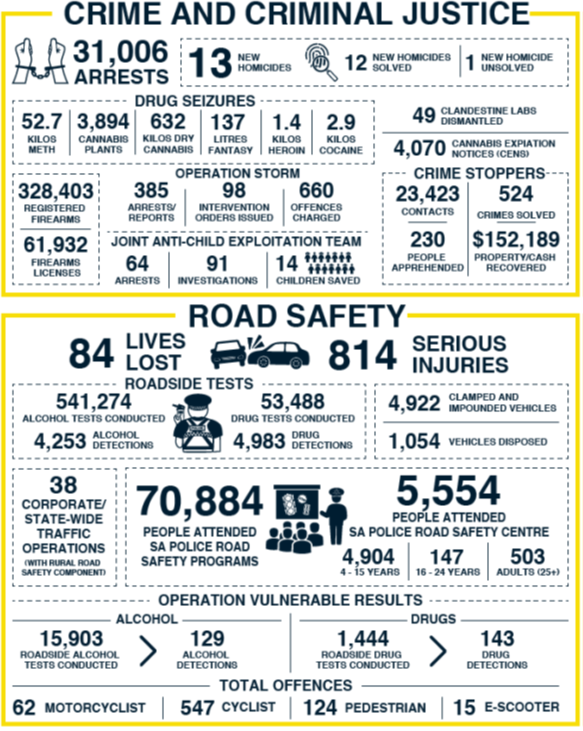
Our focus on reducing domestic abuse in the community continued throughout 2024-25, with SAPOL’s Operation Storm, beginning in July 2024. State-wide this offender-centric operation focused on those domestic violence offenders identified as having an elevated level of threat to victims. While I, like all police, would like to see far less domestic abuse occurring in our community, it is important to maintain pressure on all existing and potential offenders to show we have zero tolerance of this behaviour. The results from Operation Storm are encouraging, with 385 arrests and reports, 98 intervention orders issued and 660 offences charged in 2024-25. In addition, SAPOL dedicated an experienced team to work closely with and directly support, the South Australian Royal Commission into Domestic, Family and Sexual Violence.
Police Officer of the Year is an annual award presented by the Rotary Club of Unley, in partnership with SAPOL; to acknowledge police officers whose service and personal dedication have made a lasting and profound impact on their community. Senior Constable Chris Mailley based in Naracoorte, was named 2024 Police Officer of the Year, for his tireless support for family and domestic violence victims, and other members of his local community.
In addition, SAPOL`s Senior Constable Lyn Gibson`s exemplary work was acknowledged at the SA Kornar Winmil Yunti (KWY) Corporation Annual Focus Awards Gala. Senior Constable Gibson was awarded the Jo Shanahan Award in September 2024, in recognition of her exceptional advocacy and leadership within SAPOL in family violence intervention.
Organised crime involvement rising from the illegal tobacco market has been a major focus this year, with SAPOL’s Operation Eclipse coordinating investigation and seizure efforts across the state to seize large quantities of illicit tobacco associated serious criminal offending; and disrupt criminal networks. Operation Eclipse commenced in September 2024, working in partnership with SA Consumer and Business Services. Operation Eclipse has so far resulted in 37 arrests for offences including money laundering, blackmail, serious criminal trespass, arson and sale/possession of illicit tobacco. There have been 190 searches on residential, business and commercial premises, three firearms, $2.2 million in cash and in excess of $26.2 million in illicit tobacco products have been seized. $22.8 million of assets are subject to restraint application.
As part of a long-standing national agreement between all Australian state and territory Police Commissioners, between January and February 2025 SAPOL supported Northern Territory Police with 40 active operational personnel deployed to Alice Springs Their task was to assist NT Police with rising levels of youth violence.
For some years, there have been rapid and significant changes in SAPOL’s operating environment, together with a steady increase in the South Australian population. To ensure SAPOL`s operational response model (the District Policing Model) can best meet the evolving demand for police services, an external, independent review commenced during the reporting period. This review will focus on how demand for police services has impacted the model as it was designed, and what changes if any, are needed, to continue to enhance our operational service response.
Similarly, during 2024-25 SAPOL continued to develop and deliver initiatives focussed on reducing demand for front line police. A check on welfare taskings trial completed in June 2025 achieved a decrease of approximately 46 000 hours
front-line officers spent on these taskings, resulting in 10 553 fewer taskings attended. The next initiative will be reviewing SAPOLs response to mental health taskings with outcomes to be reported in the next reporting period.
I would also like to recognise a number of SAPOL members who displayed outstanding courage, dedication and leadership, and have been recognised with prestigious awards. These include Senior Constable First Class Glen Robbins who received the Individual Award for Connecting Communities for his work in Port Augusta at the 2024 Premier’s Excellence Awards. Brevet Sergeant Jordan Allely, Senior Constable Rebekah Cass, Sergeant Michael Hutchinson and the late Brevet Sergeant Jason Doig awarded Police Bravery Medals for risking their lives during two separate incidents at Crystal Brook and Senior.
Improving road safety outcomes continues to be a major focus for police and all South Australian road users. It is police officers individually who see firsthand the devastation caused by dangerous and distracted road use. In 2024-25 there were 84 lives lost and 814 serious injuries, each one representing a significant impact on the officers involved, and the families, friends and the wider community.
SAPOL maintains its commitment to alcohol and drug testing drivers, with 541 274 alcohol tests and 53 488 drug tests conducted in this reporting period.
Safe road use education is a key part of the police role. Opened in October 2024 SAPOL’s new Road Safety Centre, provides an important service to the community, purpose-built to deliver a range of free road safety skills for people of all ages in a safe and fun environment. With 5 554 people attending the centre this financial year, it is making a positive contribution. It has been developed to cater for those living with a disability, with the mock roadway including tactile ground surface indicators and accessible pedestrian signals.
New simulators allow users to experience driving under hazardous conditions, such as using a mobile phone or exceeding the speed limit are now at the centre. These simulators provide drivers with exposure to a variety of scenarios in a safe environment, helping prepare them for the complexities of real-world driving. The centre continues to provide an important role in ensuring that road safety education remains a priority for the community.
It was with deep sadness in April 2025 that SAPOL lost its youngest recruit Sam Scully (Sergeant Sammy) following his long battle with a brain tumour. After Sammy was ‘sworn in’ he was happy to take a ride in our police helicopter and work with a number of specialist areas such as Water Operations, Mounted Operations, Dog Operations and Bomb Response. I wish to personally thank the efforts and support of the many SAPOL members who helped Sammy fulfill his dream of belonging in blue.
Finally, I acknowledge the continuing hard work and commitment displayed by all SAPOL personnel throughout 2024-25, in service to the South Australian community.
Overview: about the agency
Our Purpose | Under the Police Act 1998, the purpose of South Australia Police (SAPOL) is to reassure and protect the community in relation to crime and disorder by the provision of services to uphold the law; preserve the peace; prevent crime; assist the public in emergency situations; co-ordinate and manage responses to emergencies; regulate road use and prevent vehicle collisions. |
Our Vision | SAPOLs vision of ‘Safer Communities’, recognises our continuing commitment to reduce community harm through a prevention first mindset. |
Our Values | To achieve our vision, we need to ensure our culture reflects the best personal and professional qualities for trusted and sustainable working practices. Our values that guide our behaviour and attitude are Service, Integrity, Courage, Leadership, Collaboration and Respect. |
Our functions, objectives and deliverables | SAPOLs Our Strategy 2030 and Safer Communities vision recognises police as a valued contributor to the safety and prosperity of the South Australian community. The foundation for SAPOLs quality service delivery is guided by our five principles of:
Our core programs in 2024-25 were:
|
- Commissioner
- Deputy Commissioner
- Business Service
- Crime Service
- Governance and Capability Service
- Information Systems and Technology Service
- Metropolitan Operations Service
- Operations Support Service
- People, Culture and Wellbeing Service
- Security and Emergency Management Service
- State Operations Service
Read more about the organisational structure.
Response and support to the SA Royal Commission into Domestic, Family and Sexual Violence.
During 2024-25 there was no change to the agency’s structure and objectives as a result of internal reviews or machinery of government changes.

The Hon Stephen Mullighan MP is the Minister for Police. His other portfolios include Treasurer, Minister for Defence and Space Industries and responsibility for Road Safety.
The Minister oversees South Australia Police programs of Public Safety, Crime and Criminal Justice Services and Road Safety.
| Grant Stevens is the Commissioner of Police, responsible for leading South Australia Police and the State Coordinator under the Emergency Management Act 2004. Areas reporting directly to the Commissioner include:
|
| Linda Williams is the Deputy Commissioner, responsible for assisting the Commissioner in leading South Australia Police. Areas reporting directly to the Deputy Commissioner include:
|
| Stephen Johinke is the Executive Director Business Service, responsible for:
|
| John Venditto is the Assistant Commissioner Crime Service, responsible for:
|
| Simon Watkins is the Assistant Commissioner Governance and Capability Service, responsible for:
|
| Hamish Cameron (resigned May 2025) was the Executive Director Information Systems and Technology Service, responsible for:
|
| Scott Duval (retired January 2025) was the Assistant Commissioner Metropolitan Operations Service, responsible for:
|
| Narelle Kameniar is the Assistant Commissioner Operation Support Service, responsible for:
|
| Kim-Sherie Summers is the Executive Director People, Culture and Wellbeing Service, responsible for:
|
| Philip Newitt is the Assistant Commissioner Security and Emergency Management Service, responsible for:
|
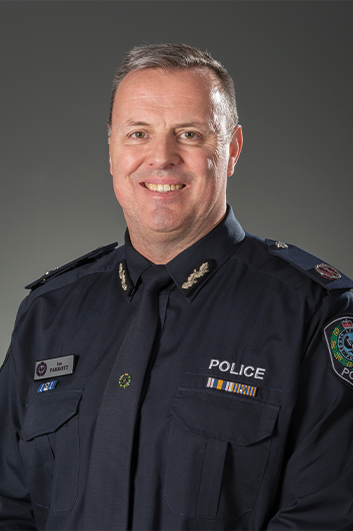
| Ian Parrott is the Assistant Commissioner State Operations Service, responsible for:
|
| Stuart McLean is the Assistant Commissioner responsible for:
|










- Police Act 1998
- Police Regulations 2014
- Firearms Act 2015
- Hydroponics Industry Control Act 2009
- Public Assemblies Act 1972
- Second-hand Dealers and Pawnbrokers Act 1996
- Witness Protection Act 1996
South Australia Police continued to work collaboratively with other emergency services and government agencies, and the Department for Correctional Services to support community safety.
The agency's performance

| Agency objectives | Indicators | Performance |
|---|---|---|
| Protective vests to protect all frontline police | Procurement and provision of additional Multipurpose Load Bearing Vests (MLBVs) for frontline police. | 1 259 MPLBVs ordered with 1 224 delivered. |
| Public Safety |
Level of Community Confidence in policing services. Percentage of Grade 1 taskings in the metropolitan area responded to within 15 minutes. Number of calls received by Call Centre. Number of 000 calls presented to Police Communications Centre by Telstra. |
72.8%* 96.9%bove the target of 80% 583 922 204 442 |
| Crime and Criminal Justice Services |
Number of recorded offences against the person as reported by/on behalf of victims per 1000 head of population. Number of recorded offences against property as reported by/on behalf of victims per 1000 head of population. |
15.5 above the projection of ≤14.5 46.8 below the projection of ≤50.7 |
| Road Safety |
Number of Road Safety Contacts issued personally involving unique expiation notices and apprehension reports/incidents reports excluding camera. Number of driver screening tests conducted. Number of SAPOL Road Safety Centre attendees, children, young adults (16-24 years) and adults (25+). Total number of people attending SAPOL road safety programs. |
173 786 541 274 above the target of 500 000 4904 children 147 young adults and 503 adults 70 884 |
* As a result of a significant national data collection methodology change in the National Survey of Community Satisfaction with Policing, previous year results are no longer comparable.
Crime Trends
Offence counts and groupings are in line with the Australian Bureau of Statistics (ABS) Australian and New Zealand Standard Offence Classification (ANZSOC).
Over the 5 year period from financial year 2020-21 to 2024-25 there has been an increase in overall recorded crime of 14% or 14 620 offences (103 263 to 117 883) for total offences against person and property.
However, in summary, from 2023-24 to 2024-25, there was a decrease in overall recorded crime of 5% or -6694 offences (124 577 to 117 883).
Total Offences Against Person and Property
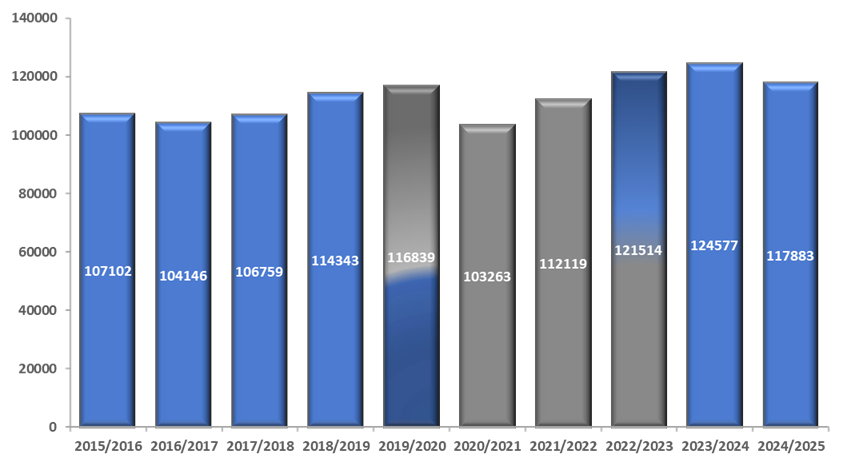
Note: to align with SAPOL`s regular monthly crime data reporting the previously published 2023-24 data has been refreshed
 COVID-19 period March 2020 - August 2022.
Crime statistics are published online at Crime Statistics each month.
Total Offences Against the Person
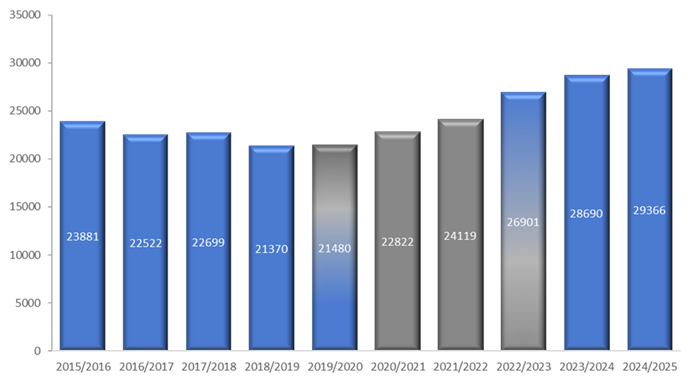
Note: to align with SAPOL’s regular monthly crime data reporting the previously published 2023-24 data has been refreshed.
COVID-19 period March 2020 - August 2022.
OFFENCES AGAINST THE PERSON | Financial Year | ||
|---|---|---|---|
2023-24 | 2024-25 | Change | |
Homicide and Related Offences | 59 | 55 | -7% |
Acts Intended to Cause Injury | 23 632 | 24 285 | +3% |
Sexual Assault and Related Offences | 2 463 | 2 432 | -1% |
Robbery and Related Offences | 816 | 724 | -11% |
Other Offences Against the Person | 1 719 | 1 830 | +6% |
TOTAL OFFENCES AGAINST THE PERSON | *28 690 | *29 366 | +2% |
Family & Domestic Abuse-Related | 13 043 | 13 721 | +5% |
* SAPOL updated crime recording and reporting systems from 1 July 2025 to align with a major crime coding revision required by the Australian Bureau of Statistics. As a result, whilst the main Person offence category totals represent all offences for the 2023-24 and 2024-25 full year, there is some minor discrepancy in the sub-category totals when compared to the overall total due to technical processing issues. This only involves a very small number of offences (1 of 28 690 for 2023-24 and 40 of 29 366 for 2024-25).
Homicide and Related Offences decreased by 7% (-4 offences).
Acts Intended to Cause Injury increased by 3% (653 offences). Within this category, Serious Assault not Resulting in Injury increased 4% (550 offences).
Sexual Assault and Related Offences decreased by 1% (-31 offences). Within this category, Aggravated Sexual Assault increased by 5% (71 offences), Non-Aggravated Sexual Assault decreased by 7% (-39 offences) and Non-Assaultive Sexual Offences decreased by 14% (-63 offences).
Robbery and Related Offences decreased by 11% (-92 offences). Within this category, Aggravated Robbery decreased by 14% (-71 offences) and Blackmail and Extortion decreased by 12% (-29 offences).
Other Offences against the Person increased by 6% (111 offences). Within this category, Dangerous or Negligent Acts increased by 32% (74 offences) and Abduction, Harassment and Other offences increased by 7% (31 offences).
Total Offences Against Property
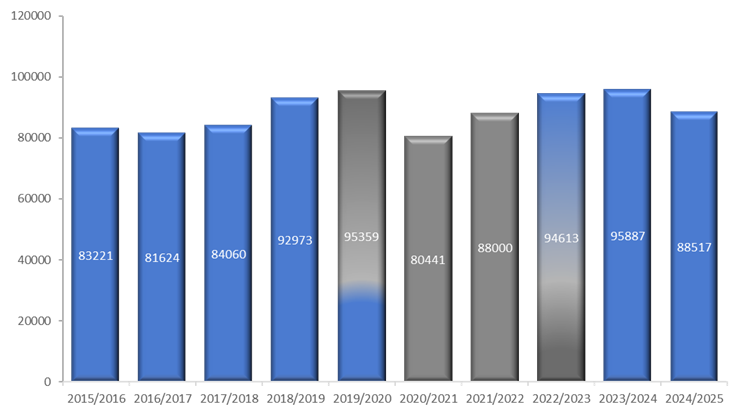
Note: to align with SAPOL’s regular monthly crime data reporting the previously published 2023-24 data has been refreshed.
COVID-19 period March 2020 - August 2022.
OFFENCES AGAINST PROPERTY | Financial Year | ||
|---|---|---|---|
2023-24 | 2024-25 | Change | |
Serious Crime Trespass | 13 070 | 12 246 | -6% |
Theft and Related Offences | 56 162 | 50 499 | -10% |
Fraud, Deception and Related Offences | 4 274 | 3 758 | -12% |
Property Damage and Environmental | 22 379 | 21 867 | -2% |
TOTAL OFFENCES AGAINST PROPERTY | *95 887 | *88 517 | -8% |
Family & Domestic Abuse-Related | 4 129 | 4 402 | +7% |
* SAPOL updated crime recording and reporting systems from 1 July 2025 to align with a major crime coding revision required by the Australian Bureau of Statistics. As a result, whilst the Property offences category totals represent all offences for the 2023-24 and 2024-25 full year, there is some minor discrepancy in the sub-category totals when compared to the overall total due to technical processing issues. This only involves a very small number of offences (2 of 95 887 for 2023-24 and 147 of 88 517 for 2024-25).
Serious Criminal Trespass (SCT) Offences decreased by 6% (-824 offences). Within this category SCT-Residence decreased by 10% (-553 offences) and SCT-Non-Residence decreased by 7% (-258 offences).
Theft and Related Offences decreased by 10% (-5663 offences). The main contributors in this category were Theft from Motor Vehicle which decreased by 19% (-1811 offences) and Other Theft which decreased by 11% (-2542 offences).
Fraud, Deception and Related Offences decreased by 12% (-516 offences). Within this category, Obtain Benefit by Deception decreased by 13% (-510 offences).
Property Damage and Environmental Offences decreased by 2% (-512 offences). The sub-categories of Property Damage by fire or explosion increased by 10% (90 offences) and Other Property Damage and Environmental decreased by 3% (-549 offences). Environmental relates to the natural world and the impact of human activity e.g. environmental noise.
Total Offences Against Good Order
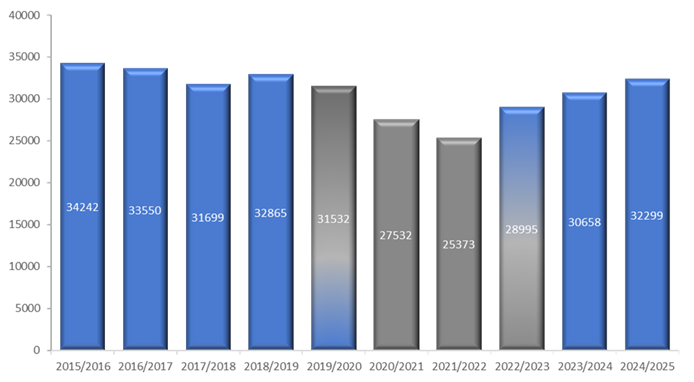
Note: to align with SAPOL’s regular monthly crime data reporting the previously published 2023-24 data has been refreshed.
COVID-19 period March 2020 - August 2022.
OFFENCES AGAINST GOOD ORDER | Financial Year | ||
|---|---|---|---|
2023-24 | 2024-25 | Change | |
Illicit Drug Offences | 4 178 | 4 368 | +5% |
Weapons/Explosive Offences | 3 041 | 2 993 | -2% |
Public Order Offences | 4 190 | 4 575 | +9% |
Justice Procedure Offences | 18 385 | 19 322 | +5% |
Other Miscellaneous Offences | 859 | 945 | +10% |
TOTAL OFFENCES AGAINST GOOD ORDER | *30 658 | *32 299 | +5% |
* SAPOL updated crime recording and reporting systems from 1 July 2025 to align with a major crime coding revision required by the Australian Bureau of Statistics. As a result, whilst the main Good Order offence category totals represent all offences for the 2023-24 and 2024-25 full year, there is some minor discrepancy in the sub-category totals when compared to the overall total due to technical processing issues. This only involves a very small number of offences (5 of 30 658 for 2023-24 and 96 of 32 299 for 2024-25).
Illicit Drug Offences increased by 5% (190 offences). The main contributor is Possess/Use Drug Offences which increased by 13% (233 offences).
Weapons/Explosives Offences decreased by 2% (-48 offences). The main contributor is Prohibited Weapons/Explosives Offences which decreased by 4% (-35 offences).
Public Order Offences increased by 9% (385 offences). Within this category, Criminal Intent increased by 15%
(66 offences) and Disorderly Conduct increased by 8% (171 offences).
Justice Procedure Offences increased by 5% (937 offences). Within this category, Breach of Bail increased by 6% (598 offences).
Total General Expiations, Cannabis Expiations and Drug Diversions
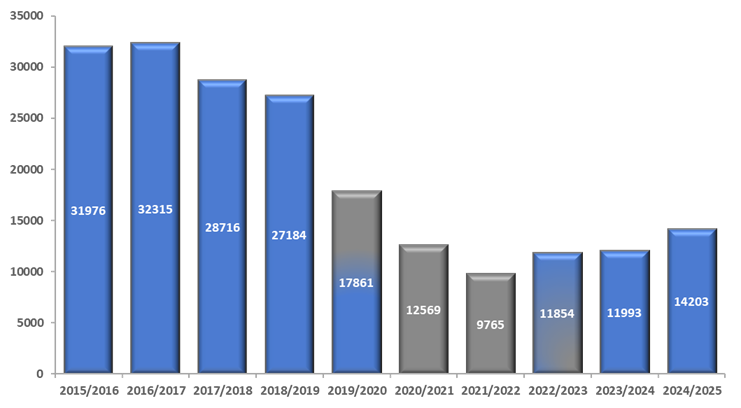
Note: to align with SAPOL’s regular monthly crime data reporting the previously published 2023-24 data has been refreshed.
COVID-19 period March 2020 - August 2022.
GENERAL EXPIATION OFFENCES | Financial Year | ||
|---|---|---|---|
2023-24 | 2024-25 | Change | |
Other Thefts (GENs) | 300 | 734 | +145% |
Other Property Damage and Environmental (GENs) | 6 | 6 | 0% |
Cannabis Expiations Notices (CENs) | 3 999 | 4 070 | +2% |
Drug Diversions | 2 761 | 3 191 | +16% |
Other Weapons/Explosives Offences (GENs) | 71 | 62 | -13% |
Other Public Order Offences (GENs) | 4 364 | 5 595 | +28% |
Other Justice Procedure Offences (GENs) | 91 | 114 | +25% |
Other Miscellaneous Offences (GENs) | 401 | 431 | +7% |
TOTAL | 11 993 | 14 203 | +18% |
Total General Expiations increased by 18% (2210 GENs).
Other theft (GENs) increased by 145% (434 GENs). This category mainly comprises Fare Evasion on Bus/Train/Taxi/Train, followed by Fail to Pay an Entrance Fee.
Other Public Order Offences (GENs) increased by 28% (1231 GENs). This category comprises Possess Liquor in Public Place Contrary to Prohibition, Consume Liquor in Public Place Contrary to Prohibition and Smoking in Vehicle while Child Present.
Program name | Performance |
|---|---|
Aboriginal Employment Register | SAPOL is committed to supporting government initiatives and programs that support the employment of Aboriginal people within the public sector. The SAPOL People Strategy 2021-2025 has one of its key priorities to attract, develop and retain a diverse workforce with an inclusive culture within SAPOL. The Office of the Commissioner for Public Sector Employment Aboriginal Employment Register is available to be accessed when filling non-sworn vacancies. |
Performance management and development system | Performance |
|---|---|
Individual Performance Management | SAPOL’s online Individual Performance Management and Development system (iEngage performance and development) runs over a 12 monthly cycle with a mid-term review six monthly before completing and recommencing. Introduced in November 2019, iEngage is focused on promoting a meaningful and purposeful feedback framework between employees and supervisors that will ensure ongoing development of the individual whilst incorporating wellbeing, performance improvement and workplace behaviour expectations. Underpinning this approach is the expectation of regular performance and development discussions between supervisors and employees. The system has two primary elements:
All eligible employees are required to have an up-to-date iEngage performance and development plan. Compliance is monitored and reported through the Executive Leadership Team monthly. |
Program name | Performance |
|---|---|
Work Health and Safety | A total of 2731 incidents were reported in the 2024-25 financial year, representing a 1% increase compared to Members of the Executive Leadership Team received refresher training to support their due diligence responsibilities as Defined Officers. SAPOL performed strongly in the Office of the Public Sector’s Risk-Based Audit for Hazard Management, receiving no non-conformances. In October, SAPOL delivered its annual Safe Work Month campaign, aligned with the National Safe Work Month. The campaign promoted the theme: 'Safety is everyone’s business'. SAPOL established a Safety Management System framework aligned with international standards for safety systems and management of psychosocial risk. Implementation will commence in 2025-26. My Safety Management system supports the SAPOL principle of ‘Our People, Our Strength’ to ensure staff are supported and equipped to make decisions that may impact their health and safety whilst at work. SAPOL developed new tools to enhance staff safety during relocations to new or refurbished buildings. These tools require both pre-occupancy and post-occupancy workplace assessments to be completed, with any identified issues communicated to staff as part of the induction process. SAPOL commenced working with high-risk workgroups to establish workgroup safety risk profiles providing the opportunity to proactively identify all hazards that have the capacity to impact staff, identify and evaluate all existing controls and to identify opportunities for improvement. SAPOL has 125 nominated Health and Safety Representatives across all services. The Worksite Inspections program achieved a 98% completion rate in 2024-25. Influenza vaccinations are available to all staff as part of the annual voluntary Influenza Vaccination Program for employees and their immediate family members. The Commissioner’s Office Health Safety and Welfare Advisory Committee convened in 2024-25, discussing matters impacting employee health, safety and wellbeing and reviewing performance trends and compliance with relevant legislation. SAPOLs Operational Safety Portfolio Committee provides a formal pathway for the review and endorsement of operational trials, new operational equipment, training or programs that may impact on SAPOL members heath safety and wellbeing. |
Employee Assistance | The Employee Assistance Program (EAP) is a confidential service provided by external service provider Corporate Health Group. The service is available to all employees and immediate family members, where up to six sessions are provided every two years. The philosophy of the EAP is based on the premise that to intervene early is to limit/prevent the risk or extent of psychological injury. The EAP is delivered by mental health professionals offering short-term support for work-related and personal problems. During 2024-25 the EAP had 342 initial consultations reflecting a 1% increase compared to 2023-24. The EAP had a total of 1021 consultations, reflecting a 9% decrease compared to 2023-24. |
Early Intervention | SAPOLs early intervention process is designed to proactively address and minimise the impact and duration of symptoms or actual injury/illness in employees with work related injuries. This is accomplished by assessing the recovery and return to work needs of the injured employee within 48 hours of an incident report, through direct contact with both the employee and their supervisor. In cases of physical injuries that do not result in time off work, SAPOLs Early Intervention Program offers injured employees timely and appropriate treatment from their preferred providers, aiding their recovery while they continue to work. If the employee is absent from work or requires intensive treatment, then referrals are made to suitable services with the goal of achieving the highest practicable levels of physical and/or mental recovery. Involvement in the program is optional and does not affect the employee’s ability to lodge a work injury claim. In 2024-25, 97% of early intervention assessments were undertaken within two business days of reporting. The early intervention assessments resulted in the following outcomes:
|
Reconditioning Program and Preferred Health Service Providers List | SAPOL maintained a range of health and wellbeing initiatives designed to promote healthy living and improve the overall health of the workforce by delivering evidenced based education/advice, providing health and fitness equipment and offering support to those in need. The Reconditioning Program links staff with appropriate allied health service providers and helps by covering any out-of-pocket expenses. All employees wishing to improve their physical health may access the program, excluding circumstances of work-related injuries. In March 2025, SAPOL partnered with the Skin Cancer College of Australasia as part of Melanoma March. This resulted in skin checks becoming part of the Reconditioning Program and included some work site inspections, with 101 requests for skin checks. In 2024-25, 416 new applications were received, representing a 25% increase from 2023-24. The Reconditioning Program is supported by SAPOL’s ‘Preferred Health Service Providers List’ which currently has over 398 allied health practitioners to provide tailored services for the unique nature of policing. Services are provided by dieticians, physiotherapists, exercise physiologists, podiatrists and sleep clinicians. |
Operation Nutrition Support | SAPOL maintained its ongoing relationship with accredited dietitians from Sprout Nutrition who designed and provide the online nutrition program “Operation Nutrition Support”. Specifically tailored to the needs of SAPOL employees, the program teaches nutrition basics and provides useful tools to select and plan meals and build healthy habits. The program was updated to further address the influence of shift work on nutritional choices, digestion, sleep, wakefulness and mood. Operational Support Service utilised Sprout’s facilities for their Health and Wellbeing Officer/Management meeting. In 2024-25 the online program had an additional 138 enrolments, increasing total employee participation to 1549 employees. |
Voluntary Health Assessments | SAPOL provides access for employees to receive body composition information using the InBody scan unit. Employees receive individual data including their muscle mass, visceral fat levels and basal metabolic rate which can inform planning and decision making with allied health practitioners to achieve physical health improvements. The purchase of a third appliance resulted in, a total of 1730 scans conducted in 2024-25 representing a 40% increase from the previous year. |
Fitness Passport | SAPOL employees and their immediate family have the benefit of reduced rate access to a variety of health and fitness centres across the state. This multi-facility “passport” has 943 current members. |
Workplace injury claims | Current year 2024-25 | Past year 2023-24 | % Change (+/-) |
|---|---|---|---|
Total new workplace injury claims* | 383 | 400 | -4% |
Fatalities | 0 | 0 | 0% |
Seriously injured workers** | 0 | 0 | 0% |
Significant injuries*** (where lost time exceeds a working week, expressed as frequency rate per 1000 FTE) | 28.2 | 32.1 | -12% |
*Excludes additional compensation claims
**Number of claimants assessed during the reporting period as having a whole person impairment of 30% or more under the Return to Work Act 2014 (Part 2 Division 5)
***As at 31 December 2024
Work health and safety regulations | Current year 2024-25 | Past year 2023-24 | % Change (+/-) |
|---|---|---|---|
Number of notifiable incidents (Work Health and Safety Act 2012, Part 3) | 20 | 13 | +54% |
Number of provisional improvement, improvement and prohibition notices (Work Health and Safety Act 2012 Sections 90, 191 and 195) | 16 | 2 | +700% |
Return to work costs* | Current year 2024-25 | Past year 2023-24 | % Change (+/-) |
|---|---|---|---|
Total gross workers compensation expenditure ($) | $25,803,773 | $23,050,809 | +12% |
Income support payments - gross ($) | $12,698,128 | $10,239,996 | +24% |
*Based on 12 months of data before third party recovery.
Data for previous years is available at: https://data.sa.gov.au/data/dataset/annual-reporting-data
Executive classification | Number of executives |
|---|---|
Commissioner | 1 |
Deputy Commissioner | 1 |
Assistant Commissioners | 6 |
SA Executive Service Level 2 | 2 |
SA Executive Service Level 1 | 15 |
Data for previous years is available at: https://data.sa.gov.au/data/dataset/annual-reporting-data
The Office of the Commissioner for Public Sector Employment has a workforce information page that provides further information on the breakdown of executive gender, salary and tenure by agency.
Financial Performance
The following is a brief summary of the overall financial position of the agency. The information is unaudited. Full audited financial statements for 2024-2025 are attached to this report.
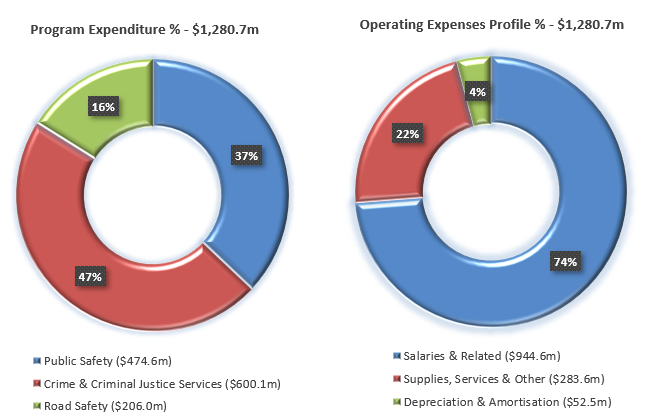
Statement of Comprehensive Income | 2024-25 *Budget $000s | 2024-25 Actual $000s | 2024-25 Variation $000s | Past year 2022-23 $000s |
|---|---|---|---|---|
Total income | 1 231 848 | 1 318 644 | 86 796 | 1 244 248 |
Total Expenses | 1 154 033 | 1 280 677 | 126 644 | 1 130 566 |
Net Result | 77 815 | 37 967 | (39 848) | 113 682 |
Other Comprehensive Income | 142 443 | |||
Total Comprehensive Result | 77 815 | 37 967 | (39 848) | 256 125 |
* The 2024-25 budget is the 2024-25 original budget that aligns to the 2024-25 State Budget Paper 4.
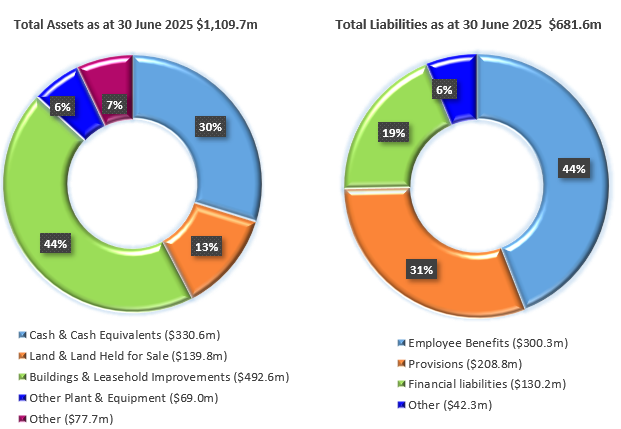
Statement of Financial Position | 2024-25 *Budget $000s | 2024-25 Actual $000s | 2024-25 Variation $000s | Past year 2022-23 $000s |
|---|---|---|---|---|
Current assets | 345 499 | 352 685 | 7 186 | 404 409 |
Non-current assets | 628 761 | 757 000 | 128 239 | 678 256 |
Total assets | 974 260 | 1 109 685 | 135 425 | 1 082 665 |
Current liabilities | 199 790 | 202 488 | 2 698 | 222 027 |
Non-current liabilities | 430 549 | 479 118 | 48 569 | 470 029 |
| Total liabilities | 630 339 | 681 606 | 51 267 | 692 056 |
| Net assets | 343 921 | 428 079 | 84 158 | 390 609 |
| Equity | 343 921 | 428 079 | 84 158 | 390 609 |
The following is a summary of external consultants that have been engaged by the agency, the nature of work undertaken, and the actual payments made for the work undertaken during the financial year.
Consultancies with a contract value below $10,000 each
Consultancies | Purpose | $ Actual Payment |
|---|---|---|
EDU.AU Pty Ltd | Response Extended Hours Roster - mid trial review (Sleep and Fatigue Management) | $3 400 |
Consultancies with a contract value above $10,000 each
Consultancies | Purpose | $ Actual Payment |
|---|---|---|
Associate Professor Dr Joshua Roose | National Socialist Network expert report and subsidiary - Counter Terrorism | $14 700 |
Total | $18 100 | |
Data for previous years is available at: https://data.sa.gov.au/data/dataset/annual-reporting-data
See also the Consolidated Financial Report of the Department of Treasury and Finance for total value of consultancy contracts across the South Australian Public Sector.
The following is a summary of external contractors that have been engaged by the agency, the nature of work undertaken, and the actual payments made for work undertaken during the financial year.
Contractors with a contract value below $10,000
Contractors | Purpose | $ Actual Payment |
|---|---|---|
All contractors below $10,000 each - combined | Various | $29 285 |
Contractors with a contract value above $10,000 each
Contractors | Purpose | $ Actual Payment |
|---|---|---|
Access Testing Pty Ltd | Agency staff engaged for testers for e-projects | $464 829 |
AG Security Group | Private security guards sourced by Police Security Services Branch (PSSB) for existing service delivery | $64 924 |
Akkodis Australia Consulting | Agency staff engaged for services relating to IS&T activities | $265 955 |
Akkodis Australia Talent | Agency staff Services | $3 087 530 |
Alarm Monitoring Australia | Private security guards sourced by Police Security Services Branch (PSSB) for existing service delivery | $287 094 |
Allegro Recruitment Consulting Pl | Agency staff engaged for services relating to IS&T activities | $100 214 |
Bailey Abbott Pty Ltd | Agency staff engaged for services relating to IS&T activities | $57 175 |
Chamonix It Management | Agency staff engaged for services relating to IS&T activities | $456 755 |
Chandler Macleod Group Ltd | Agency staff engaged to provide administrative and other services | $67 588 |
Chloe Luu Consulting | Claims Management Services | $67 140 |
Corporate Health Group Pty Ltd | Agency staff engaged to assist with the role of the Police Medical Officer | $731 513 |
DFP Recruitment Services | Agency staff engaged to provide administrative services | $956 801 |
Dialog Pty Ltd | Agency staff engaged for services relating to IS&T activities and projects | $3 539 393 |
Edge Recruitment | Agency staff engaged to provide administrative and other services | $930 091 |
Elevate Management Consulting | Procurement Services | $33 304 |
Escient Pty Ltd | Agency staff engaged for Architecture e-projects | $1 169 668 |
Fragile To Agile (Asia Pac) Pty Ltd | Agency staff engaged for Architecture e-projects | $1 265 682 |
Halcyon Knights Australia | Agency staff engaged to provide administrative and other services | $21 567 |
Harrison McMillan Pty Ltd | Agency staff engaged to provide administrative, project work and other services | $12 680 |
Hays Specialist Recruitment | Agency staff engaged to provide administrative and other services | $3 744 884 |
Hudson Global Resources (Aust) | Agency staff engaged to provide administrative services | $273 944 |
Inner Range Pty Ltd | Provision of alarm monitoring products and services | $783 344 |
Jungal Pty Ltd | Agency staff engaged for services relating to IS&T activities | $149 064 |
NRI Australia Limited | Agency staff engaged for projects | $562 247 |
Paxus Australia Pty Ltd | Agency staff engaged for services relating to IS&T activities | $5 680 291 |
Peoplebank Australia Ltd | Agency staff services | $2 054 037 |
Planit Test Management Solutions | Agency Staff engaged for services relating to IS&T activities | $103 530 |
Procurement Partners | Procurement Services | $24 826 |
Rainy Day Recruitment | Agency staff services | $104 565 |
Randstad Pty Ltd | Agency staff engaged to provide administrative, project work and other services | $2 677 489 |
RNTT Pty Ltd | Agency staff engaged to provide administrative and other services | $33 864 |
SafeSelect | Psychometric testing of recruitment applicants | $346 410 |
State Security & Protective Services (Aust) Pty Ltd | Private security guards sourced by Police Security Services Branch for existing service delivery | $534 003 |
Stillwell Management Consultants Pty Ltd | Agency staff engaged to assist with staff recruitment | $25 701 |
Talent International (SA) Pty Ltd | Agency staff engaged for Architecture | $322 158 |
WSP Pty Ltd | One off contract service | $99 500 |
Sub Total | $31 109 760 | |
Total | $31 139 045 | |
Data for previous years is available at: https://data.sa.gov.au/data/dataset/annual-reporting-data
The details of South Australian Government-awarded contracts for goods, services, and works are displayed on the SA Tenders and Contracts website.
View the agency list of contracts.
The website also provides details of across government contracts.
Other information
On 17 July 2006, a previous Cabinet approved the Government Protective Security Framework and Policy that mandates Police Security Services Branch (PSSB) as the security provider for ‘designated’ SA Government assets along with a whole-of-government alarm monitoring service.
PSSB provides protective security services to South Australian Government sites including defined ‘protected places’ and critical infrastructure (including those determined to be high risk). PSSB deploys police security officers (PSOs) to perform various roles, including static security duties at government facilities, protective security patrols such as alarm response and proactive patrolling, and operates the Security Control Centre (SCC) providing a whole-of-government alarm and CCTV monitoring service on a cost recovery basis. PSSB continues to expand its operations, in 2023 the Branch added the District Support Section (DSS) to its structure in response to ongoing demand for front line police resources.
In October 2022 legislative amendments resulted in the transition of PSOs from the former Protective Security Act 2007 to the Police Act 1998. The transition changed the title of officers from ‘protective security officers’ to ‘police security officers’ to coincide with the expansion of their duties and authorities.
As of June 2025, several SA Government sites were designated as critical infrastructure-high risk (CI-HR) assets and subsequently determined by the Minister for Police as needing protection pursuant to the South Australian Protective Security Framework. There are currently 21 sites determined to be protected places, eight of which are also designated as CI-HR assets. This is an increase of two sites from the previous financial year, (Gepps Cross Police Complex, and a building administered by the Attorney-General’s Department).
The CI-HR assets were assessed on the basis that if they were destroyed, disrupted, degraded, harmed or rendered unavailable for an extended period there would be a significant impact on the delivery of key government services; or that the reputation of the state would be affected and there would be reduced community confidence in the SA Government’s ability to effectively conduct business. Physical security in these premises is provided by PSOs who are trained and equipped to safely manage situations. The South Australian Protective Security Framework (Physical Security) sets out the process to follow for assets designated as CI-HR, with affected agencies required to identify any resource or costing pressures through the process of Cabinet submissions to the Emergency Management Council. In 2024-25 there were no changes to the number or nature of assets determined as CI-HR.
The role of the SCC is to provide protective security services to government clients through the monitoring of electronic security devices including alarms and CCTV, coordinating an appropriate response to incidents detected, monitoring of SA Government Radio Network (SAGRN) talk groups used by SA Government clients, and raising and sending service work orders to clients for identified electronic security breakdowns.
Throughout 2024-25 PSSB’s operations continued to expand following the ongoing implementation of the DSS. When fully established the DSS will comprise 189 additional PSOs whose roles include security of people, places, and property. The DSS undertakes security-related duties traditionally undertaken by police officers and enables SAPOL to better manage demands for policing services.
As of 30 June 2025, there were 91 PSOs undertaking the expanded functions in the DSS, comprising 55 in metropolitan police custody facilities (detained person guard services) and the remainder undertaking duties such as conveyance of detained persons between custody facilities and hospitals, guarding arrested persons in hospitals, and conveyance of Guardianship of the Chief Executive children back to care placements. Recruiting remains a priority and focus to attract and retain PSOs in order to achieve the full 189 FTE as quickly as possible.
PSSB comprises 289 FTE consisting of 266 PSOs, 12 Public Sector Act employees and 11 police officers (as of 30 June 2025). A further three Public Sector Act employees are included in the expanded branch model (positions yet to be substantively filled).
The current PSO staffing model is outlined in the table below.
Section | Description | Level | Number | PSO TOTAL |
|---|---|---|---|---|
Protective Security Unit | Police security officer sergeants | OPS5 | 8 | 122 |
Police security officers | OPS3 | 114 | ||
Security Control Centre | Senior police security officers | OPS4 | 5 | 29 |
Police security officers | OPS3 | 24 | ||
District Support Section | Police security officer sergeants | OPS5 | 5 | 91 |
Senior police security officers | OPS3 | 5 | ||
Police Security Officers | OPS2 | 81 | ||
Other | Recruits in training, long-term absent (injured, Maternity Leave etc.), seconded to Academy, temporarily restricted | Various | 24 | 24 |
Over the past financial year, there have been 55 incidents at designated CI-HR sites. Of these, 27 resulted in the detention of a person. Twenty eight incidents at CI-HR sites were of a minor nature (for example, not resulting in the detention of a person).
There were a further 42 incidents at protected places where PSOs exercised their authorities, such as a lawful direction to provide identification, conducting a search, refusing entry and or the trespassing of a person from a site. A continued focus on tactical communications to de-escalate incidents rather than use of authorities has resulted in similar data compared with the previous financial year.
Data for previous years is available at: https://data.sa.gov.au/data/dataset/annual-reporting-data
Reports of alleged potential corruption within the South Australian public sector are received by SAPOL’s Anti-Corruption Section (ACS) from a variety of sources including the Office for Public Integrity (OPI), Independent Commission Against Corruption (ICAC), the Australian Crime and Intelligence Commission, the Crown Solicitors Office, SAPOL’s Internal Investigation Section, Crime Stoppers, police officers, members of the public, and from information provided pursuant to the requirements of the Public Interest Disclosure Act 2018.
Type of Investigation | 2024-25 |
|---|---|
ACS Investigation | 183 |
ACS/ICAC Joint Investigation | 0 |
In the ordinary course of business, ACS may conduct an initial investigation to assess information to determine whether there is a reasonable suspicion of corruption, or of serious or systemic misconduct or maladministration. Where such a suspicion is subsequently formed the matter is reported to OPI.
In many cases, matters may be ‘filed’ following initial assessment/investigation, where there is no reasonable suspicion of corruption and no supporting evidence to warrant further enquiries into the information. Where an offence is detected which is not corruption these matters are referred by ACS to the relevant investigation area within SAPOL.
Where ICAC or OPI have referred a matter to SAPOL to conduct an investigation, the Officer in Charge, ACS (or delegate) will determine whether the investigation is to be conducted by ACS or sent to another investigation area within SAPOL. In certain circumstances, ACS may commence an investigation into a matter, however, will advise OPI of the investigation in accordance with its reporting obligations.
The Independent Commission Against Corruption Act 2012 changed significantly in October 2021. As a result of these changes, ICAC is no longer able to refer matters to the Director of Public Prosecutions for prosecution and must instead refer a matter to a law enforcement agency for further investigation and/or prosecution. The legal definition of corruption was also amended and now limits the type of offences the ICAC has the ability to investigate and then refer to SAPOL. In March 2024 ACS engaged four investigation support officers to assist with this ICAC workload resulting from the changes to the Act.
It should be noted from time to time the Australian Commission for Law Enforcement Integrity (ACLEI) may also direct joint investigations with ACS pursuant to the Law Enforcement Integrity Commissioner Act 2006. No joint ACS/ACLEI investigations were commenced during this reporting period.
The breakdown of total ACS investigations managed during 2024-25 is recorded below:
Type of Investigation | 2024-25 |
|---|---|
Miscellaneous Assessment | 1 |
ACS Operations | 173 |
Investigations referred SAPOL area (not retained at ACS) | 9 |
ICAC Trials managed by ACS (due to legislative change) | 8 |
A breakdown of the category of the ‘public official’ alleged to have been involved in a potential issue of corruption in public administration is depicted below (as far as can be determined). Where a matter has allegedly involved more than one nominated ‘suspect’, the ‘public official’ status of the primary suspect is recorded.
Type of Investigation | 2024-25 |
|---|---|
SAPOL Police Officer - sworn (including Community Constables) | 57 |
SAPOL - unsworn/cadet | 3 |
Police Security Officer | 34 |
Other SA Public Sector/ State Government | 57 |
Local Government | 7 |
Other (includes civilians) | 5 |
Commonwealth Public Sector | 1 |
Undefine / unknown public sector employee | 19 |
Data for previous years is available at: https://data.sa.gov.au/data/dataset/annual-reporting-data
Risk management
The SAPOL Risk and Performance Committee meet to provide independent advice and assurance to the Commissioner of Police, to assist in discharging his responsibilities as they relate to SAPOL’s Risk and Assurance framework. The Committee comprises SAPOL Executives and two independent external subject matter professionals that enhance transparency and external oversight. The Committee oversees and provides advice on matters of accountability and internal controls affecting the operations of SAPOL including internal audit controls, ensuring corporate risks have been identified and addressed, while fostering an ethical and accountable environment within SAPOL. The Committee meets regularly reporting to the Commissioner of Police as required. During 2024-25 the Committee convened on five occasions.
Category/nature of fraud | Number of instances |
|---|---|
Theft by Deception (fraud) offences | 2 |
NB: Fraud reported includes actual and reasonably suspected incidents of fraud.
SAPOL has numerous processes and controls in place to prevent, identify and respond to fraud. These include SAPOL’s Fraud and Corruption Control Plan, the Financial Management Compliance Program, together with a rigorous internal audit program, monthly management reports, controlled self-assessments and risk management framework.
Further controls include (but are not limited to) policies relating to authorisations (human resources, purchase, authority to sign contracts, expenditure), segregation of duties, asset stock-takes, conflict of interest and code of conduct policies, reconciliations, access to transaction details and financial processing limits. Periodic audits are conducted at Service level that test the various controls in place.
A strategic three year rolling plan has scheduled independent, financial audits which further test the effectiveness of internal controls for potential misstatements and the detection of fraud. This is further supported by external audit activities undertaken by the Audit Office of South Australia that provides reasonable assurance and an opinion on SAPOL’s collective financial controls.
SAPOL has numerous avenues established to support the reporting of alleged potential or actual fraud by employees or community through the Internal Investigation Section and other government agencies including the Office for Public Integrity, Independent Commission Against Corruption, the Australian Crime and Intelligence Commission, the Crown Solicitors Office and Crime Stoppers.
Data for previous years is available at https://data.sa.gov.au/data/dataset/annual-reporting-data.
Number of occasions on which public interest information has been disclosed to a responsible officer of the agency under the Public Interest Disclosure Act 2018:
14
Data for previous years is available at: https://data.sa.gov.au/data/dataset/annual-reporting-data.
Note: Disclosure of public interest information was previously reported under the Whistleblowers Protection Act 1993 and repealed by the Public Interest Disclosure Act 2018 on 1/7/2019.
Reporting required under any other act or regulation
Act or Regulation | Requirement |
|---|---|
Controlled Substances Act 1984 | Section 52C(1) The Commissioner of Police must, on or before 30 September in each year (other than the calendar year in which this section becomes into operation), provide a report to the Attorney-General specifying the following information in relation to the financial year ending on the preceding 30 June: (a) the number of authorisations granted by senior police officers under sections 52A and 52B during that financial year; (b) the public places or areas in relation to which those authorisations were granted; (c) the periods during which the authorisations applied; |
For the period 1 July 2024 to 30 June 2025:
General Drug Detection Powers - Section 52A(3)
A senior police officer may authorise the exercise of powers under this section in relation to a public place. There were 36 authorisations granted by senior police officers pursuant to section 52A.
Data for previous years is available at https://data.sa.gov.au/data/dataset/annual-reporting-data.
Location | Number of authorisations | Specific Period/s Authorisation Applied |
|---|---|---|
Elizabeth City Centre & CBD, Elizabeth | 2 | 1400 31/10/24 – 2300 31/10/24 1400 07/11/24 – 2300 07/11/24 |
Victor Harbor CBD, Victor Harbor | 3 | 0800 22/11/24 – 0230 25/11/24 |
Middleton Caravan Park, Middleton | 1 | 0800 22/11/24 – 0230 25/11/24 |
Basham Pde, Port Elliot | 1 | 0800 22/11/24 – 0230 25/11/24 |
Ellis Park, Adelaide | 2 | 1300 29/09/24 – 2000 29/09/24 1500 28/12/24 – 2000 28/12/24 |
Central Oval, Port Augusta | 1 | 0900 11/08/24 – 2100 11/08/24 |
Gawler CBD, Gawler | 2 | 2230 23/08/24 – 0100 24/08/24 1800 21/12/24 – 0200 22/12/24 |
Westfield Marion, Marion | 7 | 1600 12/09/24 – 1700 12/09/24 1800 03/10/24 – 2200 03/10/24 1630 14/11/24 – 2100 14/11/24 1600 20/03/25 – 2200 20/03/25 1500 10/04/25 – 2200 10/04/25 1600 17/04/25 – 1900 27/04/25 0700 03/06/25 – 1900 03/06/25 |
Ceduna CBD, Ceduna | 1 | 1100 05/10/24 – 1100 07/10/24 |
Mary Ann Reserve, Mannum | 1 | 1200 11/01/25 – 2300 11/01/25 |
Tea Tree Plaza, Modbury | 1 | 0000 30/11/24 – 0000 13/12/24 |
Munno Para Shopping Precinct, Munno Para | 1 | 1500 12/12/24 – 2300 12/12/24 |
Bonython Park, Port Rd, Adelaide | 1 | 1330 15/02/25 - 1930 15/02/25 |
Jetty Road, Glenelg | 3 | 1900 14/12/24 – 0200 15/12/24 1930 18/01/25 – 0200 19/01/25 1900 15/03/25 – 0200 16/03/25 |
Peter Lehmann Winery, Tanunda | 1 | 1400 21/03/25 – 2300 21/03/25 |
Colonnades Shopping Centre, Noarlunga | 3 | 1000 19/03/25 – 1800 19/03/25 1000 12/05/25 – 1900 12/05/25 1000 23/06/25 – 1800 23/06/25 |
Morphettville Racecourse, Morphettville | 1 | 1400 13/12/24 – 1530 13/12/24 |
Arndale Shopping Centre, Arndale | 2 | 0900 22/01/25 – 1200 22/01/25 0900 03/04/25 – 1200 03/04/25 |
Port Pirie CBD, Port Pirie | 1 | 2300 10/05/25 – 0400 11/05/25 |
Salisbury CBD, Salisbury | 1 | 1300 29/05/25 – 1500 29/05/25 |
Drug Transit Route Deployments - Section 52B(1)
There were 20 authorisations granted by senior police officer’s for identified drug transit routes pursuant to section 52B(1).
This authorisation enabled drug detection powers to be exercised in a defined area for specified periods that do not exceed 14 days. Nil authorisations exceeded the 14-day limit.
Location | Number of authorisations | Specific Period/s Authorisation Applied |
|---|---|---|
Augusta Hwy/Princess Hwy, Port Augusta/Stirling North | 3 | 0001 12/12/24 – 2359 13/12/24 0001 23/04/25 – 2359 26/04/25 0001 06/06/25 – 2359 07/06/25 |
Sturt Hwy, Yamba | 2 | 1200 15/11/24 – 2359 15/11/24 0800 06/06/25 – 2000 06/06/25 |
Stuart Hwy, Coober Pedy | 1 | 0001 16/10/24 – 2359 18/10/24 |
Barrier Hwy, Oodla Wirra | 4 | 2230 10/07/24 – 0430 11/07/24 2100 04/09/24 – 0900 05/09/24 2100 12/03/25 – 0530 13/03/25 1900 22/05/25 – 0500 23/05/25 |
Augusta Hwy/Princess Hwy, Bungama | 4 | 2200 11/07/24 – 0430 12/07/24 2100 05/09/24 – 0900 06/09/24 2100 11/03/25 – 0530 12/03/25 0001 23/05/25 – 2359 23/05/25 |
Dukes Hwy, Bordertown | 1 | 0800 23/08/24 – 2000 23/08/24 |
Dukes Hwy, Keith | 1 | 0900 15/11/24 – 1800 15/11/24 |
Eyre Hwy, Ceduna | 1 | 0700 29/11/24 – 0700 30/11/24 |
Olympic Way, Olympic Dam | 1 | 1200 19/02/25 – 1200 22/02/25 |
Augusta Hwy, Warnertown | 1 | 1900 21/05/25 – 0500 22/05/25 |
South Eastern Freeway, Monteith | 1 | 1000 23/10/24 – 1400 23/10/24 |
Overall, there were 468 deployments where teams operated under section 52A Controlled Substances Act 1984 (CSA),including under section 66S Summary Offences Act 1953 (SOA), and section 52B in the following areas:
Deployments | 2023-24 |
|---|---|
Section 52A(2)(a) (CSA) - Licensed Premises | 163 |
Section 52A(2)(b) (CSA) - Public Venues | 2 |
Section 52A(2)(c) (CSA) - Public Passenger Carrier | 180 |
Section 52A(2)(d) (CSA) - Public Place | 38 |
Section 52B(1) (CSA) - Drug Transit Route | 32 |
Section 66S (SOA) - Declared Public Precinct (52A) | 53 |
TOTAL | 468 |
There were 2230 indications of the presence of a controlled drug, controlled pre-cursor or controlled plant during the exercise of powers under sections 52A(2)(a), 52A(2)(b), 52A(2)(c), 52A(2)(d) and 52B(1) CSA, including 66S SOA provisions.
From these 2230 indications there were 426 detections, 1346 ‘residual admits’ and 458 ‘residual denies’. As a result of the 426 detections, there were 594 arrest/reports, drug diversion and/or cannabis expiation notices initiated.
Total seizures during the Passive Alert Detector Dog (PADD) deployments under section 52A and section 52B were 131.1 grams of ecstasy, approximately 5.8 kilograms of cannabis, 107 grams of amphetamine, 113.8 grams of cocaine, 1 gram of heroin, 63 grams of other substances and 229 pieces of drug paraphernalia/equipment.
Data for previous years is available at: https://data.sa.gov.au/data/dataset/annual-reporting-data
Act or Regulation | Requirement |
|---|---|
Evidence Act 1929 | Section 49 (8) A report under subsection (7) may be incorporated in any other annual report that the Commissioner of Police or the Corporate Affairs Commission (as the case may be) is required by or under statute to make to the Minister to whom the report under that subsection is to be submitted. |
Power to Order Inspection of Banking Records - Section 49(1a)
There were 424* applications made by members of the police force pursuant to section 49(1a) of the Act for the period 1 July 2024 to 30 June 2025.
Data for previous years is available at: https://data.sa.gov.au/data/dataset/annual-reporting-data
*Counting rule change, enhancing reporting practices. Results for 2024-25 are not comparable to previous years.
Act or Regulation | Requirement |
|---|---|
Hydroponics Industry Control Act 2009 | Section 34(1) The Commissioner must, on or before 31 October in each year, submit to the Minister a report on the administration of this Act during the period of 12 months ending on the preceding 30 June. |
For the period 1 July 2024 to 30 June 2025:
Hydroponics Industry Control Act and Regulations | 2023-24 |
|---|---|
Apprehension reports | 0 |
Offences | 0 |
Expiations | 0 |
Number of applications received for Hydroponics Equipment Dealer’s Licence | 0 |
Number of applications received for approval of Hydroponics Industry Employees | 0 |
Number of applications received seeking a Ministerial Exemption from the Act | 0 |
For the purpose of this Act, a person will be taken to be carrying on the business of selling prescribed equipment by retail.
Data for previous years is available at: https://data.sa.gov.au/data/dataset/annual-reporting-data
Act or Regulation | Requirement |
|---|---|
Liquor Licensing Act 1997 | Section 128AB The Commissioner of Police must include in the Commissioner of Police’s report to the Minister responsible for the administration of the Police Act 1998 the following information in respect of each order made under Subdivision 3 in the financial year to which the report relates because of information classified by the Commissioner of Police as criminal intelligence: (a) the number of orders made; (ii) the age, gender, race and residential postcode of the persons barred. |
Barring Orders - Section 128A
There were no orders made pursuant to section 128AB of the Liquor Licensing Act 1997 for the period 1 July 2024 to 30 June 2025.
Data for previous years is available at: https://data.sa.gov.au/data/dataset/annual-reporting-data
Act or Regulation | Requirement |
|---|---|
Liquor Licensing Act 1997 | Section 128C(8) The Commissioner of Police must include in his or her annual report to the Minister to whom the administration of the Police Act 1998 is for the time being committed a record of - (a) the number of orders made under this section during the period to which the report relates; and (ii) the period for which the order was in force; and (iii) the grounds on which the order was made; and (c) any other matters the Commissioner of Police considers relevant. |
Power of Police to Clear or Close Licensed Premises - Section 128C
This report refers to orders made by Senior Police Officers to clear or close licensed premises deemed unsafe because of prevailing conditions at the premises.
There were no orders made pursuant to section 128C(8) of the Liquor Licensing Act 1997 for the period 1 July 2024 to 30 June 2025.
Data for previous years is available at: https://data.sa.gov.au/data/dataset/annual-reporting-data
Act or Regulation | Requirement |
|---|---|
Road Traffic Act 1961 | Section 47E(8) The Commissioner of Police must, in the Commissioner’s annual report to the Minister responsible for the administration of the Police Act 1998, include the numbers of drivers required to submit to an alcotest in the course of the exercise of random testing powers (otherwise than at breath testing stations established in accordance with section 47DA). |
Alcotest or Breath Analysis - Section 47E
There was a total of 541 274 driver screening tests conducted for the period of 1 July 2024 to 30 June 2025.
Of those, pursuant to section 47E there were 139 754 mobile driver screening tests conducted.
Data for previous years is available at: https://data.sa.gov.au/data/dataset/annual-reporting-data
Act or Regulation | Requirement |
|---|---|
Shop Theft (Alternative Enforcement) Act 2000 | Section 18 (1) The Commissioner of Police must, on or before 30 September in each year, prepare a report on the operation and administration of this Act during the period of 12 months that ended on the preceding 30 June. (2) A report required under this section must be incorporated in the annual report of the Commissioner of Police required under the Police Act 1998. |
For the period 1 July 2024 to 30 June 2025:
Shop Theft Infringement Notices (STIN) | 2023-24 |
|---|---|
STIN 1 issued | 0 |
STIN 1 completed | 0 |
STIN 2 issued | 0 |
STIN 2 completed | 0 |
Withdrawal of Consent (PD259) | 0 |
Community service hours for STIN 2 offence | 0 |
Apologies required for STIN 1 offence | 0 |
Apologies required for STIN 2 offence | 0 |
Apprehension Reports for breach | 0 |
Apprehension Reports for subsequent breach | 0 |
Data for the previous years is available at: https://data.sa.gov.au/data/dataset/annual-reporting-data
Act or Regulation | Requirement |
|---|---|
Summary Offences Act 1953 | Section 21K The following information must be included in the annual report of the Commissioner under section 75 of the Police Act 1998 (other than in the year in which this section comes into operation): (a) the number of weapons prohibition orders issued under section 21H; |
For the period 1 July 2024 to 30 June 2025:
Weapons Prohibition Orders | 2023-24 |
|---|---|
Number of weapons prohibition orders issued under section 21H | 9 |
Number of weapons prohibition orders revoked under section 21H | 0 |
Number of appeals under section 21J and the outcome of each appeal that has been completed or finally determined | 0 |
Breaches of Weapons Prohibition Orders | 0 |
Data for previous years is available at: https://data.sa.gov.au/data/dataset/annual-reporting-data
Act or Regulation | Requirement |
|---|---|
Summary Offences Act 1953 | Section 72A(7) The following information must be included in the annual report of the Commissioner under section 75 of the Police Act 1998 (other than in the year in which this section comes into operation) in respect of the period to which the report relates (the relevant period): (a) the number of declarations made under subsection (4) during the relevant period; |
For the period 1 July 2024 to 30 June 2025:
Metal Detector Searches | *2024-25 |
|---|---|
Number of declarations made under subsection (4) | 1 |
Number of metal detector searches carried out | 2 394 |
Number of occasions on which a metal detector search was carried out, indicated the presence or likely presence of any metal | 1 051 |
Number of occasions on which weapons or articles of a kind (referred to in Part 3A) were detected | **2 |
* The number of metal detector searches carried out has increased compared to each of the previous three financial years, reflecting a heightened operational focus, particularly on licensed premises. Consequently, there has been a rise in detection data indicating the presence or likely presence of metal, including many instances where metal was naturally present in clothing.
**Knife, Baton
With amendments to the Summary Offences Act 1953, Section 72A(7) was repealed 11 March 2025 and replaced with Section 66Z effective 12 March 2025: to be reported in the 2025-26 Annual Report data.
Data for previous years is available at: https://data.sa.gov.au/data/dataset/annual-reporting-data
Act or Regulation | Requirement |
|---|---|
Summary Offences Act 1953 | Section 72B(9) The following information must be included in the annual report of the Commissioner under section 75 of the Police Act 1998 (other than in the year in which this section comes into operation) in respect of the period to which the report relates (the relevant period) (a) the number of authorisations granted under subsection (3) during the relevant period; and (ii) the number of people searched in the exercise of powers under this section; and (iii) whether weapons or articles of a kind referred to in Part 3A were detected in the course of the exercise of powersunder this section; and (iv) the types of weapons or articles so detected; (c) the number of occasions on which the Commissioner gave consent under subsection (8) during the relevant period; |
Special Powers to Prevent Serious Violence - Section 72B
There were no authorisations under subsection 3 where Special Powers to Prevent Serious Violence were granted in the reporting period of 1 July 2024 to 11 March 2025.
With amendments to the Summary Offences Act 1953, Section 72B(9) was repealed 11 March 2025 and replaced with Section 66Y effective 12 March 2025: to be reported in the 2025-26 Annual Report data.
Data for previous years is available at: https://data.sa.gov.au/data/dataset/annual-reporting-data
Act or Regulation | Requirement |
|---|---|
Summary Offences Act 1953 | Section 72F The following information must be included in the annual report of the Commissioner under section 75 of the Police Act 1998 (other than in the year in which this section comes into operation): a) the number of occasions on which the search powers under section 72D were exercised during the period to which the report relates; and |
For the period 1 July 2024 to 11 March 2025:
This report refers to the number of occasions a police officer has exercised search powers under Section 72D for the purpose of ascertaining whether a suspected explosives offence is being or has been committed.
Explosive Powers | 2024-25 |
|---|---|
Searches section 72D | 14 |
Number of times property seized for searches section 72D | 12 |
Persons charged with explosives offences section 72D | 8 |
Nature of Property Seized 72D | 2024-25 |
|---|---|
Explosives - Commercial | 7 |
Explosives - Home Made | 5 |
Explosives - Incendiary | 0 |
Explosives - Precursor | 3 |
Explosives - Equipment | 0 |
Explosives - Explosive Device | 3 |
Explosives - Incendiary Device | 2 |
Data for previous years is available at: https://data.sa.gov.au/data/dataset/annual-reporting-data
Act or Regulation | Requirement |
|---|---|
Summary Offences Act 1953 | Section 83C (6) The Commissioner must, as soon as practicable (but not later than three months) after each 30 June, submit a report to the Minister in relation to the year ended on that 30 June stating - (a) the number of authorisations and warrants granted under this section during that year; |
The number of forced entries for the reporting period of 1 July 2024 to 30 June 2025 included:
Special Powers of Entry | 2024-25 |
|---|---|
No. of authorisations issued* | 285 |
Grounds for issue of authorisations | |
|---|---|
Deceased person believed in premises section 83C(1)(a) | 90 |
Person in premises requiring medical assistance section 83C(1)(b) | 195 |
Information reported | |
|---|---|
Deceased | 92 |
Attempt suicide / person detained (Mental Health Act)** | 27 |
Drug / Alcohol Overdose | 1 |
Concern occupant deceased | 4 |
Premises empty / unoccupied | 55 |
Medical / other assistance not specified | 55 |
No medical attention required | 36 |
Missing person - welfare grounds | 3 |
Authority not used - not required*** | 12 |
*Authorisations above were issued after concerned relatives or friends contacted police anxious about the welfare of a person who had not been seen for some time.
**Includes threats of suicide.
***Includes premises not entered.
Special Powers of Entry | 2024-25 |
|---|---|
Grounds for issue of warrants:* | |
Searching the premises for material that might assist in identifying the deceased or relatives of the deceased, section 83C(3)(a) | 0 |
Take property of the deceased into safe custody, section 83C(3)(b) | 2 |
*Property taken pursuant to warrants includes: medication and electronic devices.
Data for previous years is available at: https://data.sa.gov.au/data/dataset/annual-reporting-data
Act or Regulation | Requirement |
|---|---|
Summary Offences Act 1953 | Section 83BA(9) The Commissioner must include in the Commissioner's annual report to the Minister to whom the administration of the Police Act 1998 is for the time being committed a record of the authorisations issued under subsection (7) during the period to which the report relates. |
Overcrowding at Public Venues - Section 83BA
There were no authorisations issued pursuant to section 83BA of the Summary Offences Act 1953 relating to the overcrowding at public venues for the period1 July 2024 to 30 June 2025.
Data for previous years is available at: https://data.sa.gov.au/data/dataset/annual-reporting-data
Section 6 of the CRA requires SAPOL to take all practicable measures to ensure that the organisation and its officers, employees or agents have an awareness and understanding of the Carers Charter and take action to reflect the principles of the Charter in the provision of the relevant services of that organisation.
In addition, SAPOL must consult carers, or persons or bodies that represent carers, in policy or program development; or strategic or operational planning, relevant to carers and the persons they care for.
Awareness: There is a system to ensure all management, staff and volunteers have an understanding of the Carers Charter. |
|---|
In October 2024 SAPOL promoted National Carers Week, with the theme “Millions of Reasons to Care”. Awareness of the week and recognition of those employees and volunteers who are carers was raised via an all-staff email and intranet notice. The email included links to information on the South Australia Carers Recognition Act 2005 (the Act) and the SA Carers Charter; SAPOL’s Health, Safety and Wellbeing Branch; SAPOL’s Disability Access and Inclusion Plan 2020-2024 (DAIP) and Diversity and Inclusion Strategy 2021-2025; and further information available on the Department of Human Services website. SAPOL provides disability awareness training which contains information on the Carers Charter and the Act, and the DAIP. This training forms part of the induction program for new employees. It also serves to assist employees to understand and respond appropriately to the needs of people with a disability. SAPOL’s Constable Development Program and the Promotional Qualification Framework also incorporate disability management training. |
Consultation: There is a system to ensure consultation with carers, or persons or bodies that represent carers, in the development and review of human resource plans, policies and procedures. |
|---|
Consultation was a key component of the development of SAPOL’s DAIP. Actions under the DAIP remain ongoing pending the development of a new DAIP in the coming months. Diversity and Inclusion Branch are a central point for employees to raise issues, provide feedback or suggestions in relation to policies and procedures which affect people living with disability or carers. |
Practice: There is a system to ensure the principles of the Carers Charter are reflected in human resource practice. |
|---|
SAPOL’s People Strategy 2021-2025, Diversity and Inclusion Strategy 2021-2025 and DAIP affirm SAPOL’s commitment to being a diverse and inclusive organisation. This commitment supports the principles of the Carers Charter. SAPOL supports flexible work to assist employees in achieving some balance between work and other responsibilities (including those as a carer). There is a dedicated flexible work team and a comprehensive intranet site to assist employees in their application for flexible work. With clear policies, resources and a dedicated team there is greater awareness, understanding and acceptance of flexible work. SAPOL’s Employee Assistance Section provides counselling support to all employees for a range of reasons when sought, including issues relating to relationships, stress management and work difficulties. An external Employee Assistance Program is also available to employees on issues that impact on their wellbeing. |
Public Complaints
Complaint categories | Sub-categories | Example | Number of Complaints 2023-24 |
|---|---|---|---|
Professional behaviour | Staff attitude | Failure to demonstrate values such as empathy, respect, fairness, courtesy, extra mile; cultural competency | 27 |
Professional behaviour | Staff competency | Failure to action service request; poorly informed decisions; incorrect or incomplete service provided | 682 |
Professional behaviour | Staff knowledge | Lack of service specific knowledge; incomplete or out-of-date knowledge | 0 |
Communication | Communication quality | Inadequate, delayed or absent communication with customer | 0 |
Communication | Confidentiality | Customer’s confidentiality or privacy not respected; information shared incorrectly | 94 |
Service delivery | Systems/technology | System offline; inaccessible to customer; incorrect result/information provided; poor system design | 0 |
Service delivery | Access to services | Service difficult to find; location poor; facilities/ environment poor standard; not accessible to customers with disabilities | 10 |
Service delivery | Process | Processing error; incorrect process used; delay in processing application; process not customer responsive | 0 |
Policy | Policy application | Incorrect policy interpretation; incorrect policy applied; conflicting policy advice given | 0 |
Policy | Policy content | Policy content difficult to understand; policy unreasonable or disadvantages customer | 0 |
Service quality | Information | Incorrect, incomplete, out-dated or inadequate information; not fit for purpose | 0 |
Service quality | Access to information | Information difficult to understand, hard to find or difficult to use; not plain English | 0 |
Service quality | Timeliness | Lack of staff punctuality; excessive waiting times (outside of service standard); timelines not met | 503 |
Service quality | Safety | Maintenance; personal or family safety; duty of care not shown; poor security service/ premises; poor cleanliness | 0 |
Service quality | Service responsiveness | Service design doesn’t meet customer needs; poor service fit with customer expectations | 851 |
No case to answer | No case to answer | Third party; customer misunderstanding; redirected to another agency; insufficient information to investigate | 0 |
Total | *2167 | ||
* Excludes 35 complaints still under assessment and not categorised at the time of reporting.
Additional Metrics | Total |
|---|---|
% complaints resolved within policy timeframes | 100% |
Data for previous years is available at: https://data.sa.gov.au/data/dataset/annual-reporting-data
Service Improvements resulting from complaints or consumer suggestions over 2024-25 |
|---|
Implementation of New Complaints Management Software Integration with the Office of Public Integrity (OPI) Internal and Independent Reviews of Complaint Processes Trial of the Early Sanction Model (ESM) |
South Australia Police is compliant with Premier and Cabinet Circular 039 – complaint management in the South Australian public sector | Yes |
South Australia Police has communicated the content of PC039 and the agency’s related complaints policies and procedures to employees. | Yes |