Scams Week
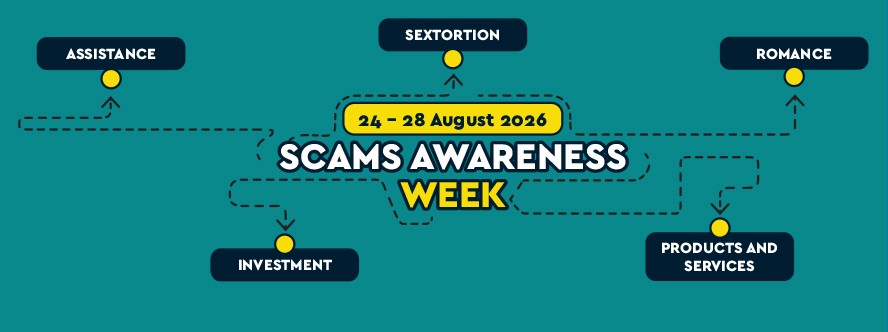
Scams Awareness Week encourages Australians to talk openly about scams, report scam activity, and help protect their communities through greater awareness and prevention.
In 2026, Scams Awareness Week will take place from Monday 24 August to Friday 28 August.
This year's theme, "No one's just a number", reminds us that behind every scam report is a real person whose money, trust, wellbeing and sense of security have been affected by criminal activity. The campaign highlights that scams can happen to anyone, regardless of age, background or experience.
The campaign continues to promote three simple steps to help Australians stay safe from scams:
- Stop: Take a moment before acting. Never provide money, personal information, passwords or banking details if you are unsure.
- Check: Verify who you are dealing with. Ask yourself whether the email, text message, phone call, social media post or investment opportunity could be fake.
- Protect: Act quickly if something does not feel right. Contact your bank immediately, secure your accounts, and report scams to the relevant authorities.
Scammers often use pressure, urgency and convincing stories to manipulate people into making quick decisions. By stopping, checking and protecting, Australians can reduce the risk of becoming victims of scams.
Scams Awareness Week is run by the Australian Competition and Consumer Commission (ACCC) on behalf of the Scam Awareness Network and supported by the National Anti-Scam Centre.
The campaign brings together government agencies, law enforcement, businesses, financial institutions, telecommunications providers, consumer groups and community organisations to strengthen Australia's response to scams.
Talking about scams helps remove the stigma often experienced by victims and encourages people to seek support sooner. Every report helps authorities better understand scam trends, disrupt criminal activity and protect others from becoming victims.
During Scams Awareness Week, South Australia Police will focus on some of the most common and harmful scams affecting South Australians, including:
- Investment scams
- Romance scams
- Sextortion scams
- Assistance scams
- Products and services scams
Learn how to recognise the warning signs, understand how scammers operate, and discover practical steps you can take to protect yourself, your family and your community.
Dating and romance scams often take place through online dating websites, but scammers may also use social media or email to make contact.
These scams are also known as ‘catfishing’. Scammers typically create fake online profiles designed to lure you in. They may use a fictional name, or falsely take on the identities of real, trusted people such as military personnel, aid workers or professionals working abroad.
Once trust is established, the scammer will share elaborate stories and ask for money, for example to cover costs with illness, injury, family crises, or travel.
Red flags:
- A convincing sob story highlighting the need to borrow money.
- Quick to fall in love or you develop a fast, close friendship.
- Promises of love, overly flirtatious and complimentary.
- They ask you to only trust them and keep things secret.
- Scammers may send their victim small gifts to “ensure they are genuine”.
- Their webcam isn’t working.
- Promises to meet in person, however there is always an excuse to delay/postpone.
- Scammers will tell you what to say to bank tellers/checkout operators when they ask what you want money/gift cards for.
Tips to help keep you safe:
- Never send money to someone you haven’t met in person.
- Always consider the possibility that the approach may be a scam and try to remove the emotion from your decision.
- Conduct an image search of your admirer to help determine if they really are who they say they are.
- Be alert to things like spelling and grammar mistakes, inconsistencies in their stories and other signs that it may be a scam such as their camera never working.
- Be cautious when sharing personal pictures or videos with prospective partners, especially if you’ve never met them before. Scammers are known to blackmail their targets using compromising material.
Watch video
Australians lose more money to investment scams than any other type of scam. They involve promises of big payouts, quick money, or guaranteed returns.
In addition to the traditional way of transferring funds through bank transfer, cryptocurrency is becoming more popular because of the perceived anonymity it offers. Crypto scams often aim to gain private information such as security codes or trick an unsuspecting person into sending cryptocurrency to a compromised digital wallet.
Red flags:
- Advertisements on social media for investment opportunities.
- Celebrity endorsements for strange or unknown brands/companies.
- Low-risk, high-reward investments that seem ‘too good to be true’.
- ‘Crypto experts’ offering free financial advice.
- Complex investment strategies that are confusing or unclear.
- Asking you to lie to banks or family about your investment.
Tips to help keep you safe:
- Visit a trusted financial advisor for investment advice and opportunities.
- Celebrity-endorsed videos are often created by artificial intelligence called DeepFake. These can often look convincing but blurred images and strange movements can give them away, so scrutinise any videos.
- Do not send copies of identification such as your driver’s licence, passport or Medicare card to people or businesses that you are unfamiliar with.
- Watch out for poor grammar and spelling. A legitimate company will take great care in having a professional look throughout their site.
- If it seems too good to be true, it probably is. Do your research!
Sextortion is a form of online blackmail where a perpetrator threatens to expose sexually compromising images, video footage, or information.
Scammers often manipulate or coerce someone into sending intimate images or videos and then threaten to share them unless a payment is made.
Victims under 18 are overrepresented in this offence type, with minors being vulnerable to this type of offending.
Red flags:
- Conversation quickly turns intimate, with the scammer asking for explicit images.
- Their profile has little to no photos and you have no mutual friends with them.
- The messages might be written in broken English, have typos or an unusual use of common phrases. Their profile details might not add up with what you see.
- They may send intimate images or videos to “prove” they are real.
- The person is extremely attractive, and it may appear too good to be true.
- Attempts are made to move the conversation off the original platform.
Tips to help keep you safe:
- Refuse friend requests from people you do not know personally.
- Avoid sending intimate images and videos online as you never know where they may end up.
- Conduct research on their account such as how long the account has been active and who their followers are.
- Beware what you share online and ensure your settings are on private. Some scammers may include their own ‘personal’ information, which could be a local area they live nearby. They could have obtained information off your account that makes them appear more legitimate.
- Refuse demands for payments which may include gift cards and cryptocurrency.
- Protect children by keeping all computer/phone use to common family areas.
- Install parental controls on mobile devices to prevent calls or texts to strangers.
- Younger people should speak to a trusted adult for support and or are encouraged to engage with family, mental health services or other community support services.
Watch video
Assistance scams refer to a wide variety of scams where assistance is offered to an unknowing victim. These may include:
- Pop-up scams
- Tech support
- NBN impersonation
- Unsolicited payments
- Scam recovery companies.
In each example, the victim will receive a call, text message, email or pop-up stating that something is wrong and that they can assist the victim in repairing what has occurred.
Examples of this include such things as removing a virus from a computer or fixing their internet speed. The scammer may push you into buying unnecessary software or a service to ‘fix’ the computer or ask you for your personal details, including your bank or credit card.
Red flags
- Unsolicited texts, emails, or calls advising of an issue that you were unaware of.
- Requests for you to download a program on your phone or PC to help you.
- Scammers ask you to transfer funds to keep your money safe.
- Pressure to act quickly to ensure you do not lose money.
- Claims untrustworthy employees are working at your banking institution.
- Scammers ask you not to tell your friends or family.
- They utilise emotions such as fear to switch off your rational mind, leading to impulsive decisions and missing red flags.
- Using complicated technical language which is confusing.
Tips to help keep you safe
- Hang up and contact the organisation on a known, reputable number. Do NOT trust contact details given to you by the caller.
- Never download programs or applications at the request of someone over the phone.
- Remember that you can still receive scam calls from a private number. If in doubt, hang up and ring the organisation back.
- Do not be intimidated by technical language or pushy behaviour.
- Make sure your computer is protected and regularly updated with anti-virus and anti-spyware software. Conduct your own research first and only purchase software from a source that you know and trust.
- Enable multi-factor authentication (MFA) on your accounts where possible to ensure an extra layer of security.
- Never provide one-time passcodes (OTPs) to unknown callers.
If you have been scammed, do not trust companies claiming to recover your funds. These are often the same people conducting the original scam.
Watch video
A products and services scam is an umbrella term that covers marketplace scams, fake health and medical products and online shopping, however the techniques used are consistent across all scams under this term.
A common method used are advertisements which offer products at unbelievably low prices and offer benefits that appear too good to be true.
Scammers may also ask you to pay for products and services using untraditional methods or may ask for deposits before receiving the product.
Red flags
- Asking for payment in cryptocurrency or gift cards.
- Offerings that appear “too good to be true”.
- Requests for personal information when it may not be relevant.
- Asking for upfront fees or deposits before seeing goods.
- Websites that look like reputable companies but offer substantial discounts.
Tips to help keep you safe
- When purchasing items online, only utilise secure payment methods that offer buyer protection such as credit cards or PayPal. Avoid unusual payment methods like cryptocurrency or gift cards.
- Conduct research on the business or property utilising google maps and other website archive tools. Although a company has an ABN, phone number, or address listed, these may not always be legitimate.
- Be wary of services that have too many positive reviews but lack any detail. Genuine reviews often include photos or comments about the service, with negative reviews providing valuable information.
- Beware of ‘Email Spoofing’ that occurs when someone forges the “From:” section of an email making it appear the email address is from a legitimate sender. Contact the sender using an alternative method.
- Check the URL for any misspellings or special characters included, even when you think you are on a trusted webpage.
If you have been affected by a scam, support is available.
- Talk to trusted friends and family members.
- eSafety Commissioner: www.esafety.gov.au
- Victims of Crime SA: www.voc.sa.gov.au
- Lifeline: 13 11 14 or www.lifeline.org.au
- Relationships Australia SA (RASA): www.rasa.org.au
Reporting scams
If you have suffered harm or loss because of a scam, report it through ReportCyber and notify your bank or financial institution as soon as possible. You can also attend your local police station.
For information on current scams, warnings and prevention advice, visit Scamwatch.
Follow the SA Police social media channels throughout Scams Awareness Week for scam alerts, prevention advice and information about emerging scam trends affecting South Australians.
Learn more
To learn more about scams and cybercrime currently affecting Australians, visit the SAPOL Scams and Cybercrime webpage.